Firdaria: The Planetary Periods of Your Life
Updated October 4, 2026
Firdaria divide your life into planetary periods of fixed length, one after another, in a 75-year cycle: the Sun rules your first ten years if you were born by day, the Moon your first nine if you were born at night. Each planet's period then splits into seven sub-periods, one for each classical planet.
Years in each bar; the nodes are outlined (North Node 3 years, South Node 2). Horoskopos uses the top two rows by default, with the nodes closing the cycle as in Abu Ma'shar. The bottom row is the night order read from Bonatti, with the nodes straight after Mars, an option under Display ▸ Methods.
What is firdaria in astrology?
Firdaria (singular firdar, also spelled fardār) is a time-lord technique from Persian astrology, passed on through astrologers writing in Arabic. The earliest surviving accounts go back to the Persian astrologer al-Andarzaghar, and the fullest is in Abu Ma'shar's 9th-century On the Revolutions of the Years of Nativities, where it sits alongside profections and solar returns as a way of judging the years of a life. Through Latin translations it reached medieval European astrologers such as Guido Bonatti.
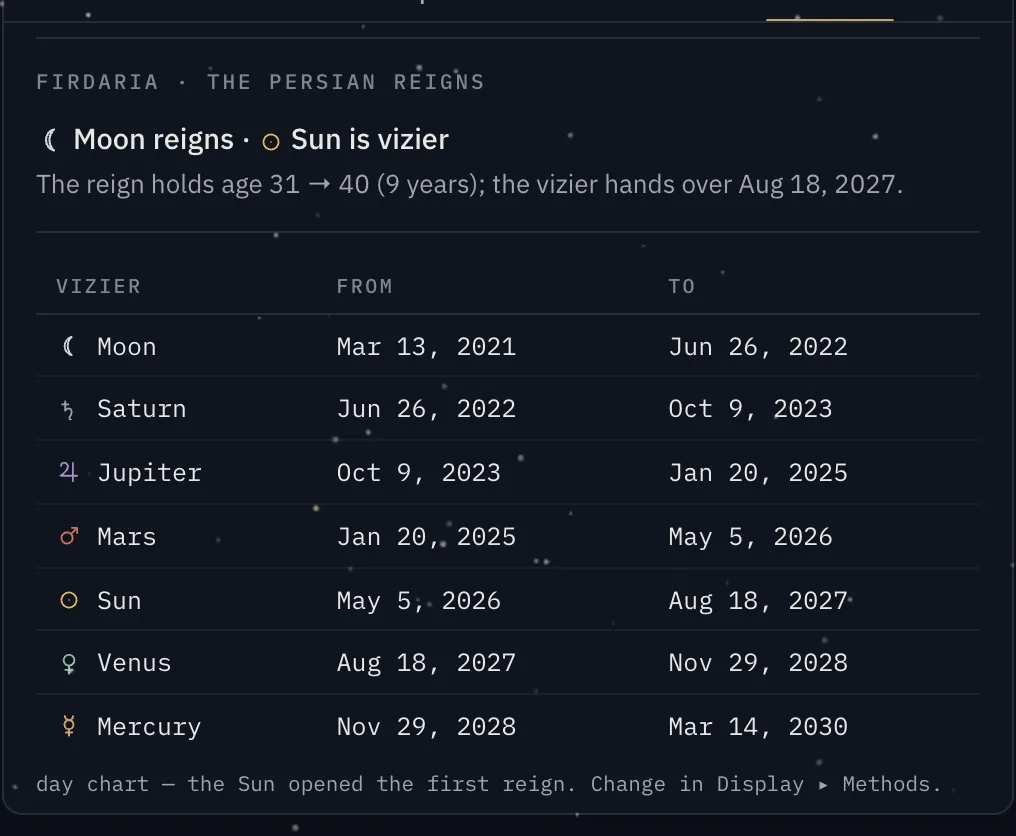
Each planet takes a turn governing your life for a set number of years, and its condition in your birth chart says something about the tone of those years. Horoskopos calls each period a reign and each sub-period's planet the vizier, the adviser who shares the ruler's work.
Day-chart and night-chart sequences
The order depends on sect: whether the Sun was above or below the horizon when you were born. The planets always follow the same chain, the order of their spheres from the Sun downward and round again: Sun 10 years, Venus 8, Mercury 13, Moon 9, Saturn 11, Jupiter 12, Mars 7. A day chart starts that chain at the Sun, a night chart at the Moon. The two lunar nodes have short periods of their own, 3 and 2 years, and the total comes to 75. At 75 the cycle starts again from the beginning.
| Day chart | Night chart (Abu Ma'shar, the default) | Night chart (Bonatti, an option) |
|---|---|---|
| Sun 0–10 | Moon 0–9 | Moon 0–9 |
| Venus 10–18 | Saturn 9–20 | Saturn 9–20 |
| Mercury 18–31 | Jupiter 20–32 | Jupiter 20–32 |
| Moon 31–40 | Mars 32–39 | Mars 32–39 |
| Saturn 40–51 | Sun 39–49 | North Node 39–42 |
| Jupiter 51–63 | Venus 49–57 | South Node 42–44 |
| Mars 63–70 | Mercury 57–70 | Sun 44–54 |
| North Node 70–73 | North Node 70–73 | Venus 54–62 |
| South Node 73–75 | South Node 73–75 | Mercury 62–75 |
Where do the nodes go in a night chart?
This is the main point of disagreement. In a day chart the nodes come after Mars, at ages 70 to 75, and the sources agree. In a night chart there are two arrangements.
- Nodes at the end. Abu Ma'shar says plainly that the nodes follow Mars in a day chart and Mercury in a night chart, so in both they govern ages 70 to 75. So does al-Andarzaghar, an earlier Persian source quoted by later compilers.
- Nodes after Mars. Some modern astrologers read a shorter, ambiguous passage in al-Qabisi and Bonatti as putting the nodes straight after Mars in a night chart too, at ages 39 to 44. Robert Zoller, an influential modern teacher of Bonatti, taught this order.
Horoskopos uses the first arrangement by default, with the nodes at the end, as in Abu Ma'shar and al-Andarzaghar, the earliest texts that spell the order out. The Bonatti/Zoller order is an option under Display ▸ Methods (the eye icon above the wheel), and the Firdaria panel of a night chart says which order it is using. The two agree until age 39 and then differ, as the last two columns show.
How to calculate firdaria by hand
Using the birth data in Horoskopos's sample library (Elizabeth II, 21 April 1926, 02:40, Mayfair, London): she became queen on 6 February 1952, at about 25.8 years old.
- 1Decide your sectSun below the horizon at her birth: a night chart
- 2Find the periodWalk the night sequence: Moon 0–9, Saturn 9–20, Jupiter 20–32
- 3Find the sub-period lengthThe period's years ÷ 7: 12 ÷ 7 = about 1.71 years
- 4Count the sub-periods passed25.8 − 20 = 5.8 years in; 5.8 ÷ 1.71 ≈ 3.4, so the 4th is running
- 5Name the sub-rulerStart with the period's own lord and follow the chain: Jupiter, Mars, Sun, Venus
Seven equal sub-periods of about 1.71 years. Outlined: Venus, June 1951 to February 1953, which holds the accession. The coronation in June 1953 fell in the next one, Mercury's.
Both placements of the nodes give the same answer here, since the difference only begins at 39. In her chart, Jupiter sits in Aquarius in the 2nd house and Venus is in Pisces, the sign of its exaltation. That is the sort of thing a reader would weigh, as illustration rather than proof.
Sub-periods: why each period divides into seven
Each planetary period is shared out equally among the seven classical planets. The ruling planet keeps the first share, and the others follow in the same chain (Sun, Venus, Mercury, Moon, Saturn, Jupiter, Mars), wrapping back to the start.
One seventh of the period's years. The nodes' periods have no sub-periods.
Abu Ma'shar says the nodes govern alone, because they rule no signs. Horoskopos measures everything in tropical years of 365.24219 days from your exact birth moment, so its dates may differ by a few days from a hand count.
How to interpret firdaria
The period lord sets the overall tone; the sub-ruler colours the stretch within it.
- 1The lord's natal conditionIts sign, house, dignity, and whether it belongs to the chart's sect. A planet in good condition tends to describe an easier period.
- 2The houses it rulesThese topics tend to come forward.
- 3The sub-ruler with the lordWhether the two aspect each other, and whether they are friendly by nature.
- 4Other time lordsWhen the lord of the year is also the firdaria lord or sub-ruler, many astrologers give that planet extra weight.
Firdaria describe long periods; the annual profection narrows to a single year, and zodiacal releasing adds another view of the same years. In Horoskopos the Timeline marks each new period and sub-period, and the Moment view shows the firdaria lord and sub-ruler beside the profection year and releasing period for any date.
The Saturn period, the Mercury period and others
These are the traditional themes, offered as starting points. The lord's own condition in your chart always matters more.
- Sun: visibility, authority, the sense of self. In a day chart it opens life.
- Moon: the body, home, change and daily life. In a night chart it opens life.
- Mercury: learning, skill, writing and trade. Its 13 years are the longest period.
- Venus: affection, pleasure, art and partnership.
- Mars: effort, conflict and decisive action, in a short seven-year period.
- Jupiter: growth, support, standing and generosity.
- Saturn: responsibility, structure, patience and slow results. A Saturn period is not simply a bad one: it often describes work that lasts.
- North and South Node: short periods, with the North Node usually read as adding and the South Node as taking away.
Do I need a birth time?
Yes. Firdaria depend on whether you were born by day or night, and Horoskopos decides that from the Sun's altitude at your birthplace. Without a birth time and place it can't, so it leaves firdaria out rather than guessing. If you were born close to sunrise or sunset, check your birth time carefully: a few minutes can change your sect, and with it the whole sequence.
Sources and further reading
- Abu Ma'shar, Persian Nativities IV: On the Revolutions of the Years of Nativities (trans. Benjamin Dykes, Cazimi Press, 2019). The fullest medieval account of the firdaria, with profections and solar returns; places the nodes at ages 70–75 in every chart.
- Steven Birchfield, "The Fardārāt in Nativities" (revised 2020). Sets the passages from Abu Ma'shar, al-Qabisi and Bonatti side by side on the night-chart order of the nodes.
- Guido Bonatti, Book of Astronomy (trans. Benjamin Dykes, Cazimi Press, 2007). Bonatti's treatise on nativities includes the brief account of the firdaria behind the "nodes after Mars" reading.