Annual Profections: Find Your Profection Year and Lord of the Year
Updated October 4, 2026
Your profection year is the house your current year of life activates: divide your age in completed years by 12 and add 1 to the remainder. Count that many signs from your rising sign, and the planet that rules that sign is your lord of the year.
Age means the birthday you have most recently had: from your 30th birthday to your 31st is "age 30". Add 12 to keep going round, so 72, 84 and 96 are 1st house years again.
How to calculate your profection year
You need your age and your rising sign. Each birthday the Ascendant moves forward one whole sign, so the first year of life belongs to the 1st house, the second to the 2nd, and at 12 you are back at the 1st.
- 1Take your agecompleted years: 27
- 2Divide by 12, keep the remainder, add 127 ÷ 12 leaves 3, so a 4th house year
- 3Count that many signs from your rising signTaurus 1, Gemini 2, Cancer 3, Leo 4
- 4Its ruler is the lord of the yearLeo is ruled by the Sun
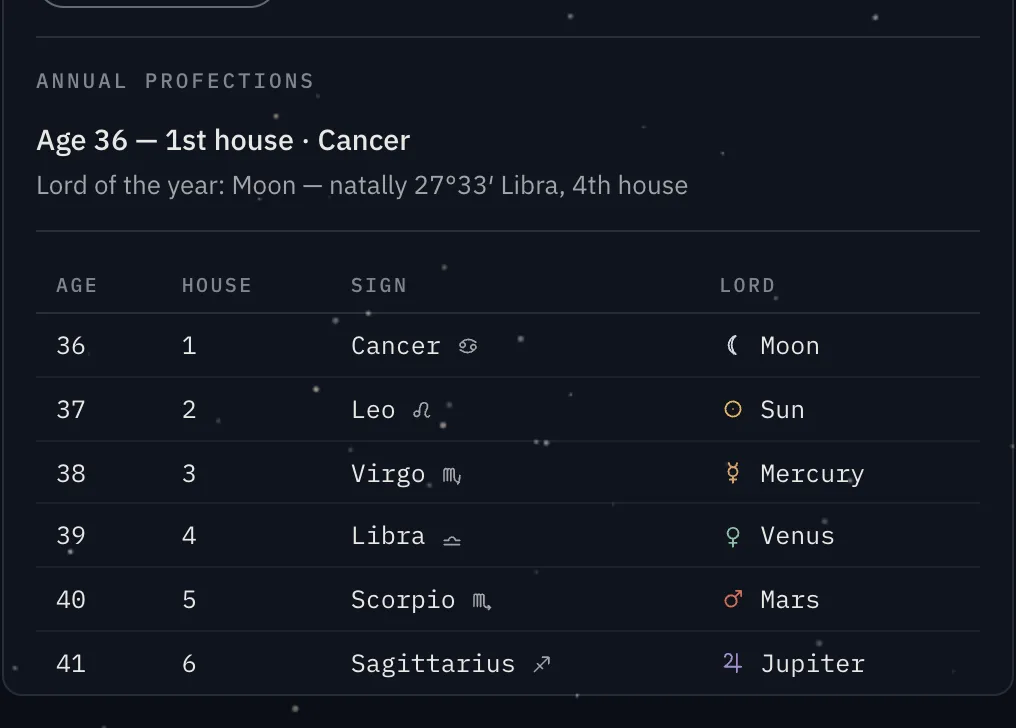
In Horoskopos the year turns on the anniversary of your birth moment. The Time lords tab shows the current year and the five after it, with the lord's natal degree, sign and house, and the Timeline marks each birthday as a profection turn.
What is the lord of the year?
The lord of the year, sometimes called the time lord of the profection year, is the domicile ruler of your profected sign. Traditional profections use the seven visible planets only, and so does Horoskopos.
| Profected sign | Lord of the year |
|---|---|
| Aries, Scorpio | Mars |
| Taurus, Libra | Venus |
| Gemini, Virgo | Mercury |
| Cancer | Moon |
| Leo | Sun |
| Sagittarius, Pisces | Jupiter |
| Capricorn, Aquarius | Saturn |
For twelve months this planet steps forward. Its natal placement, its condition and its movements during the year carry more weight than usual, and the topics of the house it rules come into focus, along with those of the house it occupies.
Profection years house by house
These are the traditional themes of each house, offered as places to look rather than predictions.
- 1st house year (0, 12, 24, 36…): you, your body and bearing, new starts. The chart ruler is also the lord of the year, which makes these years feel personal.
- 2nd (1, 13, 25…): resources, livelihood, what you can rely on.
- 3rd (2, 14, 26…): siblings, neighbours, short trips, letters and daily conversation.
- 4th (3, 15, 27…): home, parents, land, roots and endings.
- 5th (4, 16, 28…): children, pleasure, creativity; the Hellenistic name is "Good Fortune".
- 6th (5, 17, 29…): work routines, service, strain and the things that need tending.
- 7th (6, 18, 30…): partners, open dealings with others, agreements.
- 8th (7, 19, 31…): traditionally the house of death, which is why people search for the "8th profection year" with some worry. In practice it is read for inheritance, debts and shared resources, endings and what you let go of. It is not a forecast of a death.
- 9th (8, 20, 32…): travel, study, belief, the wider world.
- 10th (9, 21, 33…): career, reputation, public action.
- 11th (10, 22, 34…): friends, allies, hopes and benefactors.
- 12th (11, 23, 35…): solitude, retreat, the unseen; often a quieter close to the cycle before the 1st house year begins again.
How to read your profection year
The house tells you the topic; the lord of the year tells you how it goes.
- 1The lord's natal conditionDignity, angularity, and whether it belongs to the chart's sect. A well-placed lord tends to describe an easier year.
- 2The lord's transitsIts ingresses, stations and aspects to your natal chart during the year.
- 3The profected sign itselfNatal planets in that sign, and transits through it this year, add detail.
For sect, see day chart or night chart. The Time lords tab gives you the lord's natal degree, sign and house beside the year; the Timeline lays out its transits.
Worked example: Einstein's year of 1905
Using the birth data in Horoskopos's sample library (Albert Einstein, 14 March 1879, 11:30 local mean time, Ulm), the rising sign is Cancer at 11°39′. Einstein turned 26 on 14 March 1905.
- 126 ÷ 12 leaves 2, plus 1a 3rd house year
- 2Count from CancerCancer 1, Leo 2, Virgo 3
- 3Virgo's ruler Mercury is lord of the year, 14 March 1905 to 14 March 1906
- 4Mercury natally3°09′ Aries, in the 10th house of public work and reputation
The 3rd house is traditionally linked with letters and communication. His four papers of 1905, the work that later made his name, all appeared in print within that year: the planet of writing and thought, placed in the house of public standing, held the year. This is one famous chart chosen after the fact. It shows how the technique reads, not that it works.
Why whole sign houses matter
Profections come from the same Hellenistic tradition that counted houses by whole sign, where each house is exactly one sign, and the technique moves one sign per year. In a quadrant system such as Placidus, house sizes vary, so "the next house" and "the next sign" stop being the same thing. Horoskopos always profects by whole sign from the rising sign, even if you have switched the wheel to another house system for display. See whole sign vs Placidus.
Where profections come from
Vettius Valens, in the 2nd century, says to divide the year of life by 12 and count the remainder in signs, not only from the Ascendant but from every planet, so that each point passes the year on to another. Ptolemy (Tetrabiblos IV.10) also gives one sign per year, counted from the Ascendant, the Lot of Fortune, the Sun, the Moon and the Midheaven. Medieval astrologers such as Abu Ma'shar combined profections with solar returns and firdaria.
Modern practice, shaped by Robert Schmidt, Chris Brennan and others, puts the profected Ascendant first and treats the ruler of the sign it reaches as the planet in charge of the year. That is the version Horoskopos calculates.
Annual profection vs solar return
Many astrologers use both. The profection names the planet and the house in charge of the year; the solar return, a chart cast for the moment the Sun returns to its natal degree, describes the year's conditions in more detail. A common approach is to find the lord of the year first, then see how that planet stands in the solar return. The Time lords tab has both: the solar return card gives the exact return moment and a link to cast the return chart against your natal chart.
Frequently asked questions
Does the profection year start on your birthday?
In Horoskopos, yes: the year runs from the anniversary of your birth date and time to the next. Some astrologers start it at the solar return instead, which usually falls within a day of the birthday. Monthly profections, which divide the year further, are not calculated in the app.
What if I'm 35?
35 ÷ 12 leaves 11, plus 1, so 35 is a 12th house profection year. So are 11, 23, 47, 59, 71 and 83.
Do I need an exact birth time?
You need a birth time accurate enough to know your rising sign, because everything is counted from it. If your Ascendant is near the start or end of a sign, a small error can shift every year by one sign. Without a birth time, Horoskopos shows the chart without angles or houses and leaves the profections out rather than guessing.
Once you know your lord of the year, the next layer is the longer chapters: zodiacal releasing and firdaria both describe periods of several years.
Sources and further reading
- Vettius Valens, Anthologies (trans. Mark Riley; free via Skyscript). Book IV, chapter 11: dividing the year of life by 12 and counting the transmissions from the Ascendant and the planets.
- Claudius Ptolemy, Tetrabiblos (trans. F. E. Robbins, Loeb, 1940), IV.10, "Of the Division of Times" at LacusCurtius. One sign per year from five starting points.
- Abu Ma'shar, Persian Nativities IV: On the Revolutions of the Years of Nativities (trans. Benjamin Dykes, Cazimi Press, 2019). The medieval synthesis of profections, solar returns and firdaria.
- Chris Brennan, Hellenistic Astrology: The Study of Fate and Fortune (Amor Fati, 2017). The modern account of annual profections and the lord of the year.
- Demetra George, Ancient Astrology in Theory and Practice, vol. 2 (Rubedo Press, 2022). The twelve places and their topics, with an overview of Hellenistic timing procedures.