Day Chart or Night Chart? How Sect Changes Your Birth Chart
Updated October 4, 2026
If the Sun was above the horizon when you were born, you have a day chart. If it was below, you have a night chart. Traditional astrologers call this sect, and it decides which planets in your chart are read as the most helpful and which as the most difficult.
Sunrise and sunset move with the seasons and with where you were born, so your clock time is only a rough guide. What counts is the Sun's position against your birthplace's horizon at your birth minute.
- Sect light: Sun
- Benefic of sect: Jupiter
- Malefic of sect: Saturn
- Benefic contrary to sect: Venus
- Malefic contrary to sect: Mars
- Lot of Fortune: Ascendant + Moon − Sun
- Firdaria open with the Sun
- Sect light: Moon
- Benefic of sect: Venus
- Malefic of sect: Mars
- Benefic contrary to sect: Jupiter
- Malefic contrary to sect: Saturn
- Lot of Fortune: Ascendant + Sun − Moon
- Firdaria open with the Moon
How do I know if I have a day or night chart?
On the wheel. Find the AC (Ascendant, east) and DC (Descendant, west) marks on the rim. The line joining them is your horizon. If the Sun is on the MC side of that line, it's a day chart. If it's on the IC side, it's a night chart.
Use that line, not the house numbers. Horoskopos turns the wheel so the 1st house starts at the left, and with whole sign houses the Ascendant usually falls partway through the 1st house sign, so the horizon line is tilted by anything up to 30°. A Sun early in the rising sign, ahead of the Ascendant degree, has already risen: it's above the horizon even though it's counted in the 1st house. (With Equal, Porphyry or Placidus houses the line is level, because those systems start the 1st house at the Ascendant degree.)
With the calculator. The Signature panel on the Overview tab answers the question directly.
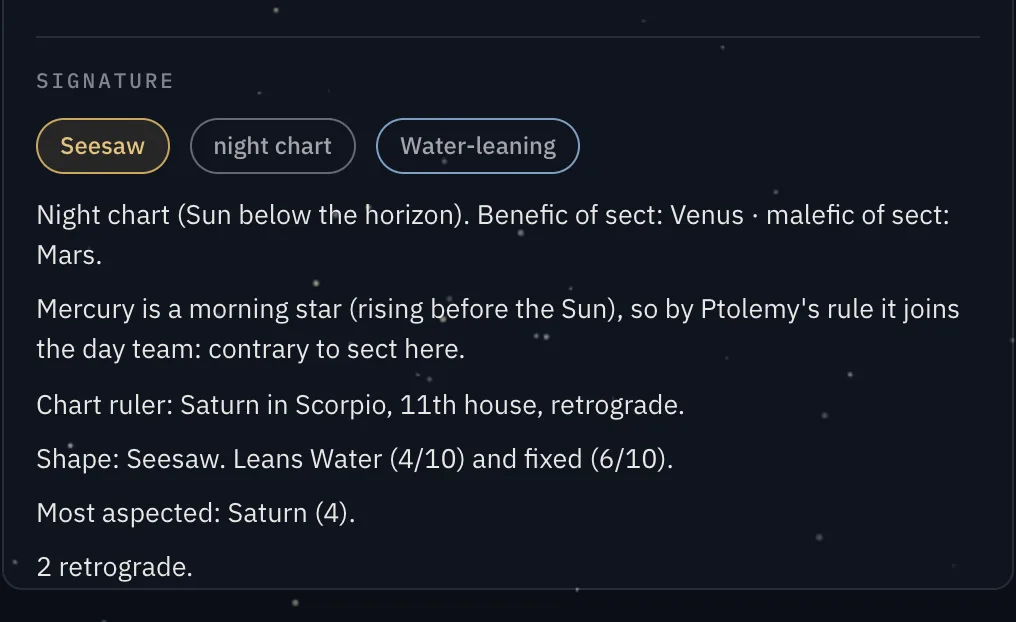
Horoskopos works out the Sun's altitude at your birthplace for the exact minute you were born. Zero or above is a day chart, below zero a night chart. You need a birth time and place for this. With "time unknown" ticked, the chart is drawn for noon without a horizon, and sect is left blank rather than guessed.
Born near sunrise or sunset
Published sunrise and sunset times mark the moment the top edge of the Sun's disc touches the horizon. Horoskopos measures the centre of the disc, allowing for normal atmospheric refraction, so its day begins slightly after the published sunrise and ends slightly before the published sunset. For London, Ulm and Mexico City the gap is roughly one to two minutes.
Recorded birth times are often rounded to the nearest five or fifteen minutes, so a birth that close to the horizon may have no certain sect, and practitioners differ on how to treat a Sun sitting right on it. If yours is within a degree or two, read the chart both ways and see which describes you better.
What is the sect light?
The luminary in charge of your chart: the Sun in a day chart, the Moon in a night chart. Ancient authors lean on it. Dorotheus judges the overall fortune of a life from the triplicity lords of the sect light, and in firdaria your first period belongs to it.
The day team and the night team
Valens describes the Sun taking Jupiter and Saturn into its sect and the Moon taking Venus and Mars (Anthology II.1 in Riley's translation). Ptolemy gives the physical reasoning (Tetrabiblos I.7): the cold of Saturn is assigned to the warmth of day and the dryness of Mars to the moisture of night, so each malefic is tempered by its own sect. Jupiter goes with the Sun and Venus with the Moon.
Mercury is the exception, a changeable planet that takes on the character of whatever it's with. Ptolemy makes Mercury common to both sects: diurnal as a morning star (rising before the Sun), nocturnal as an evening star (setting after it). Horoskopos applies that rule. Mercury is a morning star when it stands at an earlier zodiacal degree than the Sun, and an evening star when it stands at a later one; at an exact conjunction, a retrograde Mercury counts as a morning star and a direct one as an evening star. The Signature panel says which team Mercury joins and whether that is in sect or contrary to sect, the Placements tab marks Mercury "morning" or "evening", and the Chapters view's note on a Mercury chapter takes it into account. Valens gives another rule (Anthology III.5), that Mercury takes the sect of the planet whose bound it is in; the app mentions it but doesn't apply it.
Of sect and contrary to sect
Each chart has one benefic and one malefic of its own team, and one of each from the other:
- Benefic of sect: the planet whose good is most fully available.
- Benefic contrary to sect: still helpful, but its help is less reliable or comes with conditions.
- Malefic of sect: difficult, but restrained and workable. Valens notes that even the malefics can bestow good when they're well placed in their own sect.
- Malefic contrary to sect: the out-of-sect malefic, which modern Hellenistic teachers such as Chris Brennan and Demetra George treat as the most challenging planet in the chart.
These describe tendencies, not fate, and condition counts too. An out-of-sect malefic in its own sign, in a quiet house, reads very differently from one that's debilitated and angular. Horoskopos's Chapters view (zodiacal releasing) labels each chapter lord this way, for example "Malefic contrary to sect".
What sect changes elsewhere in the chart
Sect changes the arithmetic of several techniques, and Horoskopos applies it everywhere it's needed.
- The Lot of Fortune swaps the Sun and Moon by night, and the Lot of Spirit reverses both. The Part of Fortune guide explains why.
- Firdaria run Sun, Venus, Mercury, Moon, Saturn, Jupiter, Mars by day, and Moon, Saturn, Jupiter, Mars, Sun, Venus, Mercury by night, with the nodes' short periods closing the cycle. Authors differ on where the nodes fall in a night chart. By default Horoskopos follows Abu Ma'shar, with the nodes at the end; the Bonatti/Zoller order, with the nodes straight after Mars, is an option under Display ▸ Methods. The firdaria guide explains both.
- Zodiacal releasing runs from Spirit, Fortune or Eros, and all three depend on the day or night formula.
- Triplicity lords depend on sect, and the ruling lord earns a planet its triplicity dignity in the Placements tab (+3 in the score shown in the label's tip):
- Fire signs: Sun
- Earth signs: Venus
- Air signs: Saturn
- Water signs: Venus
- Fire signs: Jupiter
- Earth signs: Moon
- Air signs: Mercury
- Water signs: Mars
Two example charts: one day, one night
Both use the birth data in Horoskopos's sample library.
- 6 July 1907, 8:30 am, Coyoacán: Sun about 40° above the horizon
- Benefic of sect: Jupiter, exalted in Cancer and in its own bound
- Malefic of sect: Saturn in Pisces, in the 8th house
- Malefic contrary to sect: Mars, exalted in Capricorn but retrograde, in the 6th
- Mercury 6°20′ Leo, after the Sun: an evening star, so night team, contrary to sect
- Fortune at 9°51′ Cancer; firdaria open with a ten-year Sun period
- 21 April 1926, 2:40 am, Mayfair, London: Sun about 23° below
- Benefic of sect: Venus, exalted in Pisces
- Malefic of sect: Mars in Aquarius, in its own bound
- Malefic contrary to sect: Saturn, retrograde in Scorpio, also her chart ruler
- Mercury 4°40′ Aries, before the Sun: a morning star, so day team, contrary to sect
- Fortune at 9°28′ Libra; firdaria open with a nine-year Moon period
Kahlo's Sun is in Cancer and, with Leo rising, it's also her chart ruler. Mercury happens to be contrary to sect in all three sample charts: Einstein's, at 3°09′ Aries with the Sun at 23°30′ Pisces, is an evening star in a day chart. For how sect fits with whole sign houses, dignities and the time lords, see the Hellenistic birth chart guide.
Sources and further reading
- Claudius Ptolemy, Tetrabiblos (trans. F. E. Robbins, Loeb, 1940; online at LacusCurtius). Book I.7, "Of Diurnal and Nocturnal Planets", gives the reasoning for each planet's sect and Mercury's morning/evening rule.
- Vettius Valens, Anthology (trans. Mark T. Riley, free PDF at Skyscript). Book II opens with the triplicities and the day and night sects; the planet descriptions in Book I give each planet's sect.
- Dorotheus of Sidon, Carmen Astrologicum (trans. David Pingree, 1976; and Benjamin Dykes, 2017). The sect-based triplicity lords and their use in judging a life from the sect light.
- Chris Brennan, Hellenistic Astrology: The Study of Fate and Fortune (Amor Fati Publications, 2017). A full modern treatment of sect, including the benefic and malefic of and contrary to sect.
- Demetra George, Ancient Astrology in Theory and Practice, Vol. I: Assessing Planetary Condition (Rubedo Press, 2019). Sect as the first step in judging a planet's condition, with exercises.