Your Progressed Moon Phase: The 30-Year Lunation Cycle
Updated October 4, 2026
Your progressed Moon phase is the angle between your progressed Moon and your progressed Sun, read like the phase of the Moon in the sky. One full cycle takes about 29.5 years and passes through eight phases of roughly three to four years each.
Each phase is a 45° slice of the angle from the progressed Sun to the progressed Moon, measured in the direction the Moon travels. Keywords loosely after Dane Rudhyar, whose scheme this is.
What is a progressed Moon?
Secondary progressions use a symbolic key: one day after birth stands for one year of life, so your progressed chart at age 30 is the real sky 30 days after you were born. Horoskopos measures age in tropical years of 365.24219 days. The progressed planets are the real sky that many days after your birth; the progressed angles are symbolic, as explained below.
The progressed Sun gains about a degree a year. The progressed Moon moves as far in a year as the real Moon moves in a day, about 12° to 15°, which makes it the clock hand of the progressed chart.
Progressions are not a Hellenistic technique. The historian James Holden named Johannes Kepler, around 1600, as the first astrologer to mention them; Placidus de Titis spread the method in the mid-1600s; Alan Leo made it modern Western astrology's main forecasting tool with The Progressed Horoscope (1906). Chris Brennan has pointed to a brief passage in Vettius Valens that might hint at something similar, but the technique as practiced today is early modern, and its lunation-cycle reading twentieth-century.
Where is my progressed Moon now?
Two places, both reached from your chart once you've entered your birth details:
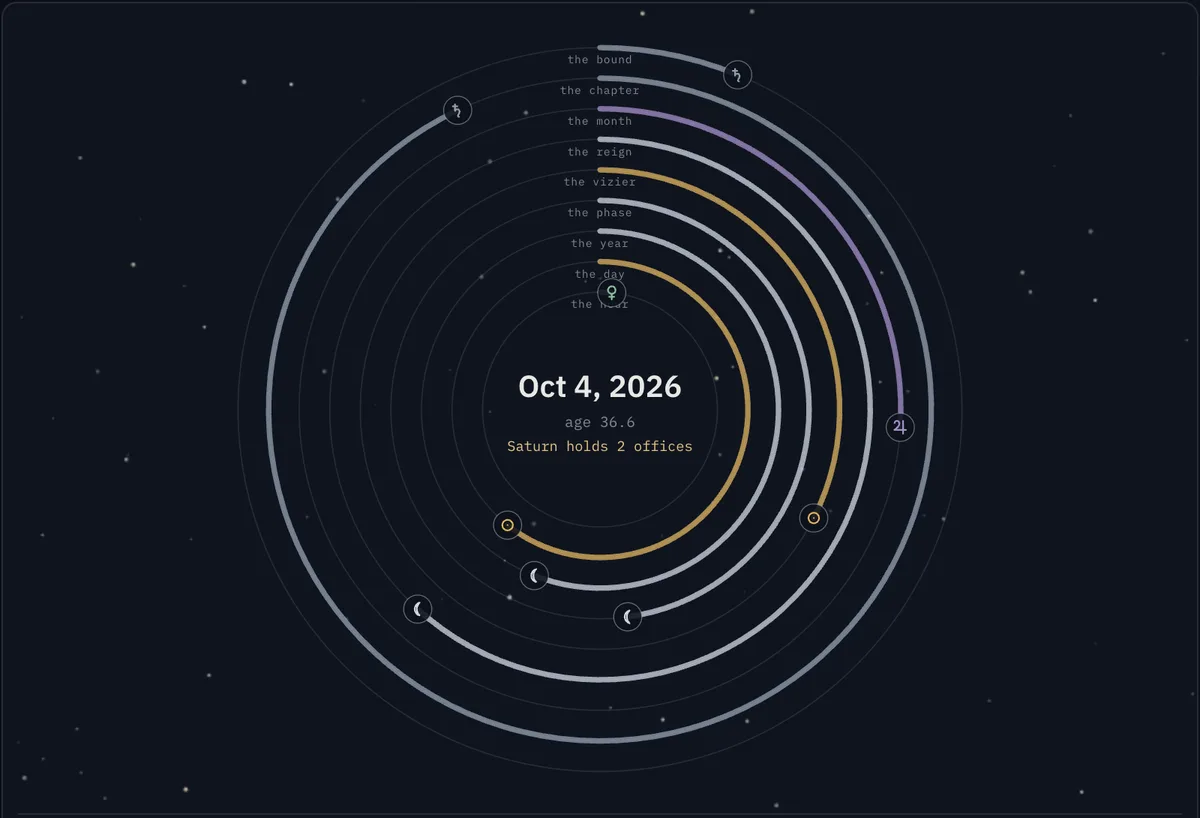
- Its phase. Open Moment. Hover the ring labeled the phase to read the phase name, for example "progressed Full Moon", with the dates it began and ends. Moment needs a birth time, because the rest of its dial is built around the Ascendant.
- Its sign and degree. Open Biwheel and under Outer wheel choose Progressed (day-for-a-year). The outer ring shows today's progressed planets around your natal chart, with progressed-to-natal aspects at orbs of about a degree or less. The time bar steps it by days, months or years, and once the progressed Moon has gone all the way round, the panel says how many times.
How often does the progressed Moon change sign?
Every 2 to 2½ years (2.0 to 2.5 in the sample charts), depending on how fast the real Moon was moving in the weeks after birth. A full lap takes about 27.3 years, so it returns to its natal degree at about 27 and again at about 55.
The progressed lunation cycle: eight phases
The eight-phase scheme comes from Dane Rudhyar. The Lunation Cycle (1967) describes eight "lunation types" of personality, by the natal Moon's phase, and gives a chapter to the progressed cycle, which he notes lasts about 29½ years. Names such as "disseminating" are his.
Horoskopos puts the boundaries at the exact 45° marks and pins each change to the day. A phase averages about 3.7 years but runs from a little over 3 to a little over 4, shorter where the progressed Moon moves quickly. Your birth phase is the natal Moon's phase: in the sample library, Einstein was born in a disseminating phase, Frida Kahlo in a balsamic phase, and Elizabeth II in a first quarter phase.
Progressed new Moon, full Moon and balsamic meanings
Rudhyar read the cycle as one process of growth. Loosely after him and the writers who followed, as themes rather than events to expect:
- Progressed new Moon. A seeding: something begins, often before you can name it.
- Crescent. The new impulse pushes free of old habits.
- First quarter. A crisis in action: commitments tested, structures built.
- Gibbous. Refining: asking what the effort is for.
- Progressed full Moon. Illumination: what was seeded becomes visible, often through relationships.
- Disseminating. Sharing and teaching what was learned.
- Last quarter. A crisis in consciousness, in Rudhyar's phrase: old forms stop fitting.
- Progressed balsamic Moon. Release: what won't carry into the next cycle falls away.
Worked example: Elizabeth II
Born 21 April 1926, 02:40, London, in a first quarter phase. The outlined phase is her first progressed new Moon, which began on 10 March 1947, six weeks before her 21st birthday.
| Phase | From | To | Age |
|---|---|---|---|
| First quarter | birth | 3 May 1929 | 0–3.0 |
| Gibbous | 3 May 1929 | 30 Mar 1933 | 3.0–6.9 |
| Full Moon | 30 Mar 1933 | 19 Nov 1936 | 6.9–10.6 |
| Disseminating | 19 Nov 1936 | 14 May 1940 | 10.6–14.1 |
| Last quarter | 14 May 1940 | 3 Oct 1943 | 14.1–17.5 |
| Balsamic | 3 Oct 1943 | 10 Mar 1947 | 17.5–20.9 |
| New Moon | 10 Mar 1947 | 28 Nov 1950 | 20.9–24.6 |
| Crescent | 28 Nov 1950 | 22 Dec 1954 | 24.6–28.7 |
| First quarter | 22 Dec 1954 | 7 Jan 1959 | 28.7–32.7 |
She married in November 1947, early in that new Moon phase, and her accession in February 1952 fell in the crescent. The next two progressed new Moons came in August 1976 and March 2006, each about 29.5 years after the last. If you still have the sample library, open her Moment page and step the dial back by years to watch the phase ring turn.
Progressed Ascendant and Midheaven: how long they stay in a sign
The real horizon on the progressed day turns right around the zodiac for every year of life, so progressed angles follow a convention instead. Horoskopos defaults to the one astro.com uses, Naibod in right ascension: the Midheaven's right ascension advances by the mean Sun's daily motion, 0°59′08″ a year, and the Ascendant follows at your birth latitude. Under Display ▸ Methods you can switch to solar arc, where the Midheaven advances by the progressed Sun's actual arc (astro.com's "MC from solar arc", and a common choice in other software), or to daily, the true sky's angles, which turn a full circle every year. The Moment page uses the choice; the Biwheel's progressed ring shows planets only, with houses from the natal chart, so it has no angles to move.
By Naibod's rate the Midheaven spends roughly 28 to 33 years in each sign. The Ascendant is much less even: for Elizabeth II in London it took about 13 years each for Pisces and Aries but about 27 for Gemini; for Kahlo, near the tropics, about 32 years each for Virgo and Libra.
The Moment page lists the progressed angle crossings in effect on a date, under a heading that names the convention in use: the progressed Ascendant or Midheaven passing over a natal planet, and progressed planets reaching the progressed angles by conjunction or opposition (the Descendant or IC). The orb starts at 1° and shrinks for slow-moving pairs, and every window is capped at two years either side.
Progressions vs transits vs solar returns
Transits are the real sky now against your birth chart: the outside weather. Progressions are a symbolic inner clock, the progressed Moon's phase describing slow changes of mood and focus. A solar return is a chart for the Sun's yearly return to its natal degree, read as the outline of that year. Many astrologers use all three, and the Biwheel's Outer wheel menu offers each: Current sky, Progressed and Solar return. For the Hellenistic way of timing the chapters of a life, see zodiacal releasing and annual profections.
Sources and further reading
- Dane Rudhyar, The Lunation Cycle: A Key to the Understanding of Personality (1967): the eight lunation types and the progressed lunation cycle; the source of the phase scheme used here.
- Alan Leo, The Progressed Horoscope (1906): the book that made day-for-a-year progressions standard in twentieth-century astrology.
- Chris Brennan and Kelly Surtees, "Secondary Progressions: Every Day Symbolizes A Year", The Astrology Podcast, episode 144 (2018): how progressions work, and their history from Kepler and Placidus to Alan Leo.
- Marilyn Busteed, Richard Tiffany and Dorothy Wergin, Phases of the Moon: A Guide to Evolving Human Nature (Shambhala, 1974): a later, more detailed treatment of the lunar phases in the humanistic tradition Rudhyar began.