When Was a Planet in a Sign, and When Will It Be Again?
Updated October 4, 2026
As of October 2026, Jupiter is in Leo: it entered on 30 June 2026 and leaves on 26 July 2027. The pass before that ran from 16 July 2014 to 11 August 2015.
Each bar runs from first entry to final exit. Twice in this span a retrograde carried Jupiter back into Cancer for a couple of months. The highlighted pass is under way now.
Search any planet in any sign
Each link opens the search with the question filled in and runs it straight away:
- Jupiter in Leo, 1950 to 2100
- Saturn in Aries, 1900 to 2100
- Saturn in Taurus, 1990 to 2040
- Venus in Scorpio, 2024 to 2030
- Mars retrograde in Cancer, 1980 to 2060
- Every Mars retrograde, 2024 to 2030
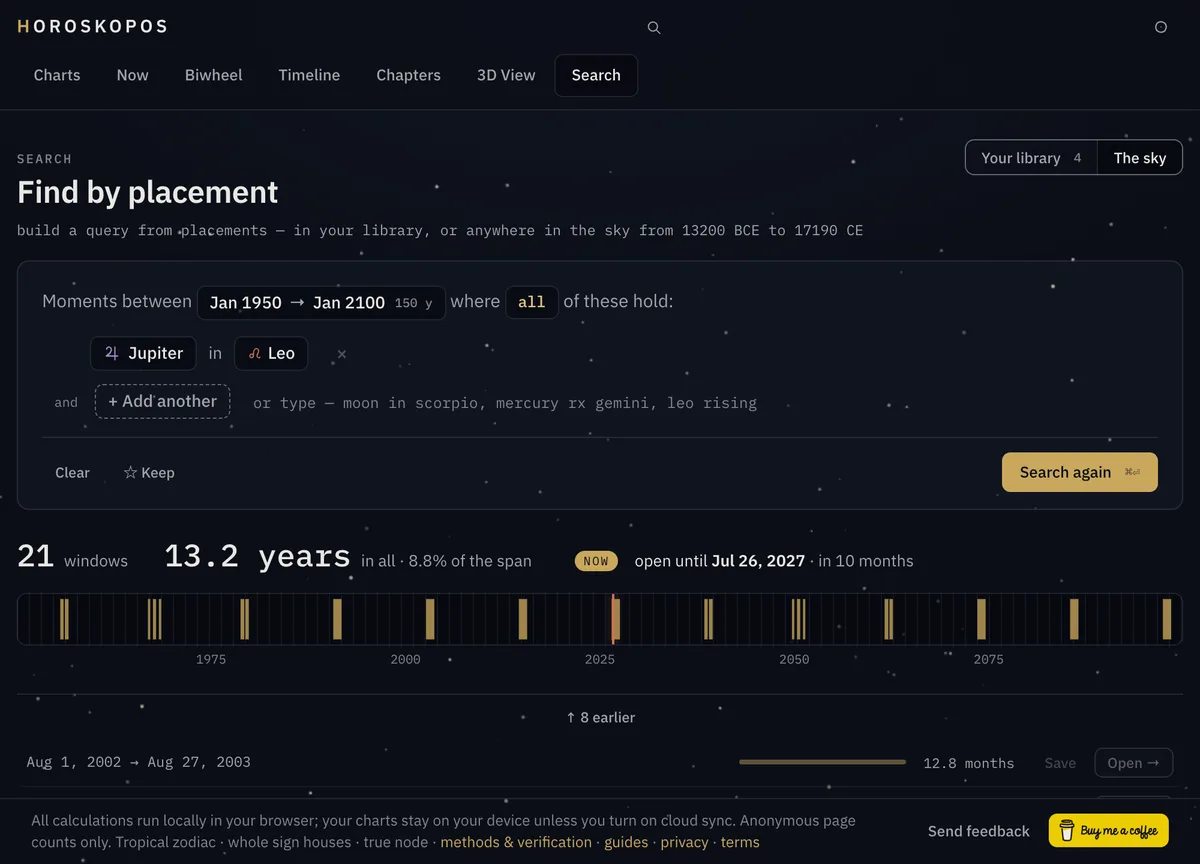
Each result is a window, the stretch of time the placement holds. Type "saturn taurus" or "mercury rx gemini" to ask something else, over any span from 13,200 BCE to 17,190 CE. Open a window to see the sky at its midpoint, or save that moment to your charts.
Dates on this page are in UTC, so a boundary near midnight UTC can land a day earlier or later where you are. Saturn's 2026 return to Aries, for example, came at 00:39 UTC on 14 February: the evening of 13 February in New York.
When was the last time Jupiter was in Leo?
Jupiter goes around the zodiac in about twelve years. Some visits to Leo are one clean year; others are split by a retrograde loop back into Cancer.
| Jupiter in Leo (UTC) | Notes |
|---|---|
| 5 Sep 1978 – 28 Feb 1979, 20 Apr – 29 Sep 1979 | Split by a retrograde into Cancer |
| 18 Aug 1990 – 12 Sep 1991 | One clean pass |
| 1 Aug 2002 – 27 Aug 2003 | One clean pass |
| 16 Jul 2014 – 11 Aug 2015 | The last completed pass |
| 30 Jun 2026 – 26 Jul 2027 | Under way now |
| 12 Jun – 16 Nov 2038, 16 Jan – 8 Jul 2039 | The next pass, split in two |
In 1966–68 there were three entries: 27 September 1966, 23 May 1967, and for good on 27 February 1968.
When was the last time Saturn was in Aries?
Saturn is in Aries now too: in on 25 May 2025, back into Pisces on 1 September, in again on 14 February 2026, and there until 13 April 2028.
segments are time in Aries; and segments are retrograde loops back into Pisces or out into Taurus. In 1937–40 Saturn entered Aries three separate times. Outlined: the window under way now.
| Saturn in Aries (UTC) | Windows |
|---|---|
| 25 Apr 1937 – 20 Mar 1940 | Three: back to Pisces 18 Oct 1937 – 14 Jan 1938; out to Taurus 6 Jul 1939, back 22 Sep 1939 |
| 3 Mar 1967 – 29 Apr 1969 | One |
| 7 Apr 1996 – 1 Mar 1999 | Two: out to Taurus 9 Jun 1998, back 25 Oct 1998 |
| 25 May 2025 – 13 Apr 2028 | Two: back to Pisces 1 Sep 2025 – 14 Feb 2026 |
| 22 Mar 2055 – 31 Jan 2058 | Two: out to Taurus 20 May 2057, back 29 Nov 2057 |
Saturn is next in Taurus from 13 April 2028 to 1 June 2030, in one unbroken window. The visit before ran from June 1998 to April 2001 in three pieces.
Why some transits have three entries
Seen from Earth, every planet except the Sun and Moon periodically seems to stop and back up: Mercury about three times a year, Venus every nineteen months or so, Mars about every 26 months, the planets from Jupiter outward once a year. A loop near a sign boundary makes two windows, or three if it straddles the line twice. Many astrologers read the crossings as one chapter: a first taste, a return to unfinished business, then the real arrival.
How long each planet stays in a sign
Measured with the app's own search engine across centuries of ephemeris (Pluto across about 1 to 3998 CE, the years its model covers). Pluto's bar is its average; its orbit is very uneven.
These count only days actually inside the sign; first entry to final exit can run longer, up to about 21 months for Jupiter and 3.7 years for Saturn. The long stays for Mercury, Venus and Mars are retrograde years, when the planet loops inside one sign.
| Body | Range of stays | Back in the same sign every |
|---|---|---|
| Moon | 2 to 2.5 days | 27.3 days |
| Sun | 29.4 to 31.5 days | 1 year |
| Mercury | 2 weeks to 69 days | about 1 year |
| Venus | 24 days to 4 months | 9½ to 13½ months |
| Mars | 38 days to nearly 8 months | about 1.9 years |
| Jupiter | about 7 to 13 months | about 12 years |
| Saturn | 2.1 to 3 years | about 29.4 years |
| Uranus | 6.3 to 7.8 years | about 84 years |
| Neptune | 13.3 to 14 years | about 164 years |
| Pluto | 12 to 32 years | about 246 years |
When was Mars retrograde?
| Retrograde (UTC) | Notes |
|---|---|
| Mars, 6 Dec 2024 – 24 Feb 2025 | In Cancer from 6 Jan; before that, Mars was retrograde in Cancer in late 2007 and the winter of 1992–93, and next will be from late 2039 into early 2040 |
| Venus, 3 Oct – 14 Nov 2026 | Under way now: stations in Scorpio, backs into Libra 25 Oct, re-enters Scorpio 4 Dec and stays until 7 Jan 2027, so this year's Scorpio visit comes in two pieces |
| Mars, 10 Jan – 1 Apr 2027 | The next Mars loop |
| Mars, 14 Feb – 5 May 2029 | The loop after that, about 25 months on |
What sign was the Moon in on my birthday?
The Moon changes sign about every two and a half days, so near an ingress the hour decides it. Enter your birth details and your chart gives the Moon's sign and degree for the exact minute, historical time zones and local mean time included. Without a birth time it is cast for noon, with no houses or angles.
Combining placements: Venus in Taurus and Moon in Cancer
Venus in Taurus with the Moon in Cancer, 2026 to 2028 returns two windows: 21–23 April 2026 and 5–7 June 2027. The search works from the slowest body first, checking the Moon only inside Venus's weeks in Taurus, so long spans come back quickly. You can also ask for "any" of several placements, or say a planet is not in a sign.
Some combinations never happen: Mercury never strays more than about 28° from the Sun, and Venus never more than about 47°. Ask for Venus in Aries with the Sun in Libra and the app says so before it runs.
Searching your saved charts for a placement
Switch the scope from the sky to your library and the same question runs against every chart you've saved: whose chart has Venus in Scorpio? Charts that miss a multi-part question by one placement are listed as near misses. A chart without a birth time is judged at noon, and flagged as uncertain if the placement could have changed that day.
How accurate are the dates?
Positions come from astronomy-engine, accurate to about an arcminute for the planets in modern centuries; for a slow planet that is an hour or more of travel. Checked against NASA JPL's Horizons ephemeris, the Jupiter, Saturn, Mars and Venus ingresses and stations on this page agree to within about an hour. Windows shorter than about four months show the clock time, longer ones the date.
Far from the present the models are extrapolations, softening toward a degree or more at the ends of the range, though a sign-level answer holds unless the planet sits near a boundary. The asteroids and Chiron can be searched only from 1800 to 2100. Dates before 1582 are proleptic Gregorian, not Julian. The methods page has the details.
Sources and further reading
- NASA Jet Propulsion Laboratory, Horizons System: the reference ephemeris used to cross-check the ingress and station dates on this page.
- Don Cross, Astronomy Engine: the open-source library behind Horoskopos's positions, documented as accurate to within about one arcminute.
- Jean Meeus, Astronomical Algorithms (Willmann-Bell, 2nd ed. 1998): the standard textbook for computing planetary positions, ingresses and stations by hand.
- Astrodienst, Swiss Ephemeris documentation: how astrology software draws on JPL's long ephemerides, and how far into the past and future they reach.