Part of Fortune and Lot of Spirit: Calculate and Read Your Lots
Updated October 4, 2026
The Part of Fortune, also called the Lot of Fortune, is a point calculated from your Ascendant, Sun and Moon: Ascendant + Moon − Sun in a day chart, and usually the reverse, Ascendant + Sun − Moon, in a night chart. Its partner, the Lot of Spirit, uses the opposite formula in each case.
- Fortune = Ascendant + Moon − Sun
- Spirit = Ascendant + Sun − Moon
- Fortune is as far from the Ascendant as the Moon is from the Sun
- Fortune = Ascendant + Sun − Moon
- Spirit = Ascendant + Moon − Sun
- Fortune is as far from the Ascendant as the Sun is from the Moon
These are the formulas Horoskopos uses. Ptolemy, and many modern astrologers, use the day formula for every chart.
The two names mean the same point; this guide mostly uses "Lot of Fortune", the older name and the one the app uses.
What is the Part of Fortune in astrology?
Lots are among the oldest calculated points in astrology. Most take the distance between two planets and set it off from the Ascendant. Hellenistic astrologers used them widely, and the medieval tradition writing in Arabic added many more, which is why they reached Latin Europe, and modern books, as "Arabic parts".
The Lot of Fortune is the most important of them. It belongs to the Moon, and Valens connects it with the body and physical circumstances: what fortune brings, rather than what you choose. He also treats it as a second Ascendant (Anthology II), counting places from it: the 10th sign from Fortune for rank, the 11th for property and goods.
How to calculate the Part of Fortune
- 1Turn each position into 0–360°Add the sign's starting degree, shown below: 13°23′ Cancer is 90 + 13°23′ = 103°23′
- 2Pick the formula for your sectDay or night, as above
- 3Do the sumAscendant + one light − the other
- 4Wrap it into the circle360 or more: subtract 360. Negative: add 360.
- 5Turn it back into a sign99°51′ is 9°51′ Cancer
Worked examples: a day chart and a night chart
Using the birth data in Horoskopos's sample library (Frida Kahlo, 6 July 1907, 08:30, Coyoacán; Elizabeth II, 21 April 1926, 02:40, Mayfair, London). The Sun was up at Kahlo's birth and below the horizon at Elizabeth's. Positions are rounded to the minute, as the app shows them.
- Ascendant 23°31′ Leo = 143°31′
- Sun 13°23′ Cancer = 103°23′
- Moon 29°43′ Taurus = 59°43′
- Fortune = 143°31′ + 59°43′ − 103°23′ = 99°51′ = 9°51′ Cancer
- Spirit = 143°31′ + 103°23′ − 59°43′ = 187°11′ = 7°11′ Libra
- Ascendant 21°23′ Capricorn = 291°23′
- Sun 0°12′ Taurus = 30°12′
- Moon 12°07′ Leo = 132°07′
- Fortune = 291°23′ + 30°12′ − 132°07′ = 189°28′ = 9°28′ Libra
- Spirit = 291°23′ + 132°07′ − 30°12′ = 393°18′, minus 360 = 3°18′ Taurus
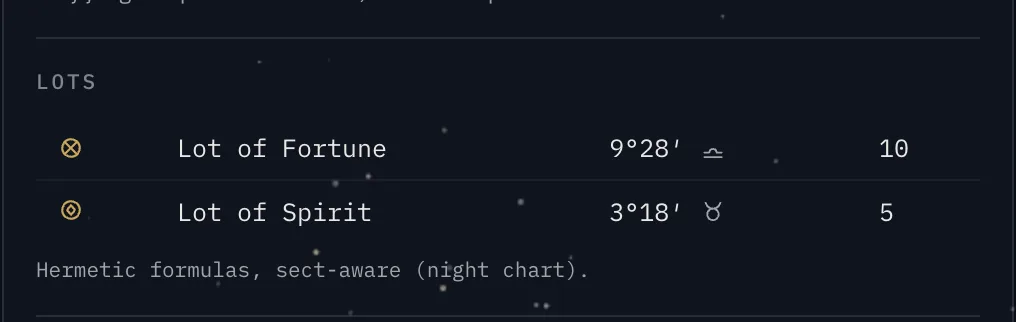
With the day formula, Elizabeth's Fortune would come out at 3°18′ Taurus, where the reversing authors put Spirit. That is why two calculators can disagree about a night chart's Fortune.
Should the formula reverse at night?
Astrologers have never fully agreed.
- Valens counts Fortune from the Sun to the Moon by day, and gives the Lot of Spirit, which he calls Daimon, as its mirror image: from the Moon to the Sun by day, from the Sun to the Moon by night. In Book III he notes that opinions differ about Fortune at night and gives his own rule: reverse it only while the Moon is above the horizon, and after moonset count from the Sun to the Moon as by day.
- Ptolemy (Tetrabiblos III.10) takes the distance from the Sun to the Moon "both by night and by day", so his Fortune never reverses.
Many modern astrologers use the day formula for everyone, as Ptolemy did, and that is a recognised choice rather than a mistake. Most astrologers working from the Hellenistic and medieval texts, Brennan among them, reverse it. Horoskopos reverses at night, without Valens's Moon-above-the-horizon refinement. If you use a calculator that doesn't reverse, its Fortune for a night chart will sit where Horoskopos puts Spirit.
Is my chart a day chart or a night chart?
Horoskopos decides sect from the Sun's altitude at your birthplace at the moment of birth: above the horizon is a day chart, below is a night chart. Some astrologers instead ask whether the Sun is above the Ascendant–Descendant line, which can give a different answer within minutes of sunrise or sunset. The Lots panel notes which formula it used. There is more in day chart or night chart.
What house is my Part of Fortune in?
In whole sign houses, the lot's house is simply its sign counted from your rising sign. Kahlo's Fortune in Cancer, with Leo rising, falls in the 12th house; her Spirit in Libra falls in the 3rd. Elizabeth II's Fortune in Libra, with Capricorn rising, falls in the 10th house; her Spirit in Taurus, in the 5th.
The house shows where in life the lot's themes tend to play out, and the ruler of the lot's sign shows how they are managed: Fortune in Cancer is ruled by the Moon, so the Moon's condition in the chart says a good deal about Fortune.
Horoskopos uses whole sign houses by default, the system the Hellenistic authors used with the lots. If you switch the chart to another house system, the Lots panel shows the house in that system instead, which can differ. See whole sign vs Placidus.
Lot of Fortune vs Lot of Spirit
The two lots form a pair, like the Sun and Moon they come from.
- Belongs to the Moon
- The body and physical circumstances
- Some summarise it as what happens to you
- Linked with Tyche, fortune or chance
- Belongs to the Sun
- Mind and action; Valens looks to it for employment and rank
- Some summarise it as what you do
- Linked with the daimon, a person's guiding spirit
The last row comes from Dorian Greenbaum's study of the pair, which connects them with those two old Greek ideas. Reading the lots together, and how their rulers relate, shows how circumstance and intention fit together in a life.
The Lots panel and the wheel show these two lots only. The tradition describes others, notably the lots that Paulus Alexandrinus attributes to Hermes. Of those, Horoskopos also calculates the Lot of Eros, in Paulus's form (by day Ascendant + Venus − Spirit, reversed by night), but only as a starting point for zodiacal releasing, where Chris Brennan uses it for love and relationships. (Valens gives a different Lot of Eros, from Fortune to Spirit.) The rest aren't calculated.
Part of Fortune vs the North Node
They are easy to confuse because both are points rather than planets, and both are linked with luck or destiny in modern writing. They are quite different.
- Calculated from your Ascendant, Sun and Moon
- Depends on your birth time and place
- Moves with the Ascendant, on average about a degree every four minutes
- Traditionally read as a place in the chart, with a ruler and a house
- Where the Moon's orbit crosses the ecliptic heading north
- Nearly the same for everyone born within days of you
- Moves slowly backward through the zodiac
- Traditionally read mainly through the planets it contacts
Modern readings of the North Node as a "life direction" are a separate, later development. Horoskopos shows the true node.
Lots in timing: zodiacal releasing
The lots are also the starting point for zodiacal releasing, the timing technique from Valens's Book IV. He releases from Spirit for employment and rank, and from Fortune for the body. In modern practice, peak periods are counted from Fortune's sign either way. Horoskopos releases from either lot, or from Eros, on its Chapters page. If Spirit falls in the same sign as Fortune, Horoskopos releases Spirit from the next sign, as Valens directs and Brennan teaches.
You can see both lots on your own chart: they appear as glyphs on the wheel and in the Placements tab, with degree, sign and house. For the full traditional toolkit, see the Hellenistic birth chart guide.
Sources and further reading
- Vettius Valens, Anthologies (trans. Mark Riley; free via Skyscript). Book II on the Lot of Fortune, the Lot of Daimon and counting places from Fortune; Book III on his night-time variant; Book IV on releasing from both lots.
- Claudius Ptolemy, Tetrabiblos (trans. F. E. Robbins, Loeb, 1940), III.10, "Of Length of Life" at LacusCurtius. The single Fortune formula for day and night.
- Dorian Gieseler Greenbaum, The Daimon in Hellenistic Astrology: Origins and Influence (Brill, 2016). A scholarly study; its chapter "Endowment and Chance" treats the Lots of Fortune and Daimon.
- Chris Brennan, Hellenistic Astrology: The Study of Fate and Fortune (Amor Fati, 2017). The lots, their calculation by sect and their use in zodiacal releasing.