A Hellenistic Birth Chart Calculator, Free and Without Sign-Up
Updated October 4, 2026
A Hellenistic chart is the birth chart as it was read in the Greek-speaking Mediterranean around two thousand years ago: one sign per house, planets sorted into a day team and a night team, and every planet judged by its condition before its meaning. A first reading usually follows a set order, sect first and timing last.
- 1SectWas the Sun above or below the horizon? That picks your team.
- 2Rising sign and its rulerThe Ascendant stands for you; its ruler is your chart ruler.
- 3ConditionDignity, sect and house of the key planets.
- 4The lotsFortune and Spirit, by the day or night formula.
- 5TimingThe profection year, then the releasing chapter and firdaria.
What's different about a Hellenistic chart?
Hellenistic astrology was written down between roughly the first century BCE and the seventh century CE, by authors such as Dorotheus of Sidon, Vettius Valens and Claudius Ptolemy. Medieval, Renaissance and modern Western astrology grew out of it, and so did much of Indian astrology. The zodiac and planets are the same as in modern astrology. The questions are different.
- Houses are usually whole signs. Most surviving Hellenistic charts work this way, though some authors also divided the quadrants between the angles. Modern software usually defaults to Placidus, so your planets can change houses: see whole sign vs Placidus.
- Day and night charts differ. Sect changes which planets are read as most helpful and which as most difficult. See day chart or night chart.
- Condition comes before meaning. How well placed a planet is (dignity, sect, house) is asked before what it signifies.
- Timing is built in. Each period of life is run by a particular planet.
What you'll see on your chart
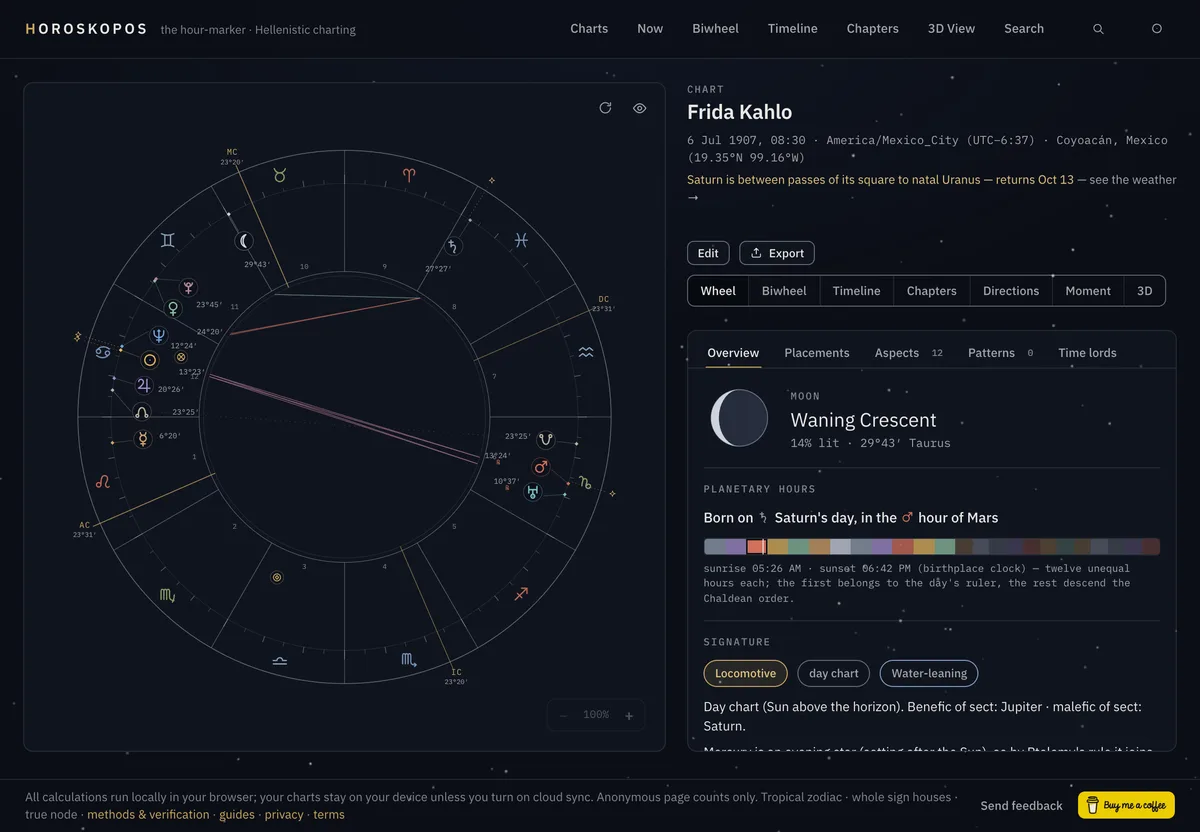
The chart opens on the wheel, with tabs underneath.
- Overview: the Moon's phase, the planetary hour you were born in, and the Signature panel, which names your sect, its benefic and malefic, the team Mercury joins, and your chart ruler with its sign and house.
- Placements: every body with its degree, house and essential dignity, then your lots and any fixed stars on a planet or angle.
- Aspects and Patterns: the conjunction and the four Ptolemaic aspects (sextile, square, trine, opposition) and the shapes they make. Like most software, Horoskopos measures aspects by degree with an orb. Hellenistic authors also counted them sign to sign, so planets in square signs are configured even when far from an exact 90°.
- Time lords: your current profection year, firdaria period and solar return.
The wheel shows Uranus, Neptune and Pluto by default. The eye icon above the wheel (Display options) has Traditional 7, which shows the Sun through Saturn with the lunar nodes, and the house system: Whole sign by default, with Equal, Porphyry and Placidus to compare. Its Methods section covers the choices where respected sources disagree (the firdaria nodes in a night chart, the length of a releasing year, and how progressed angles move), with a one-line note on each option.
Essential dignities and Egyptian bounds
- Domicile +5: in a sign it rules
- Exaltation +4: in its sign of exaltation
- Detriment −5: in the sign opposite its domicile
- Fall −4: in the sign opposite its exaltation
- Triplicity +3: ruling lord of its element, by sect (Dorothean lords)
- Bound +2: in its own Egyptian bound, a few degrees of the sign
- Decan +1: in its own 10° face, rulers in Chaldean order
- Peregrine: none of these (no points either way)
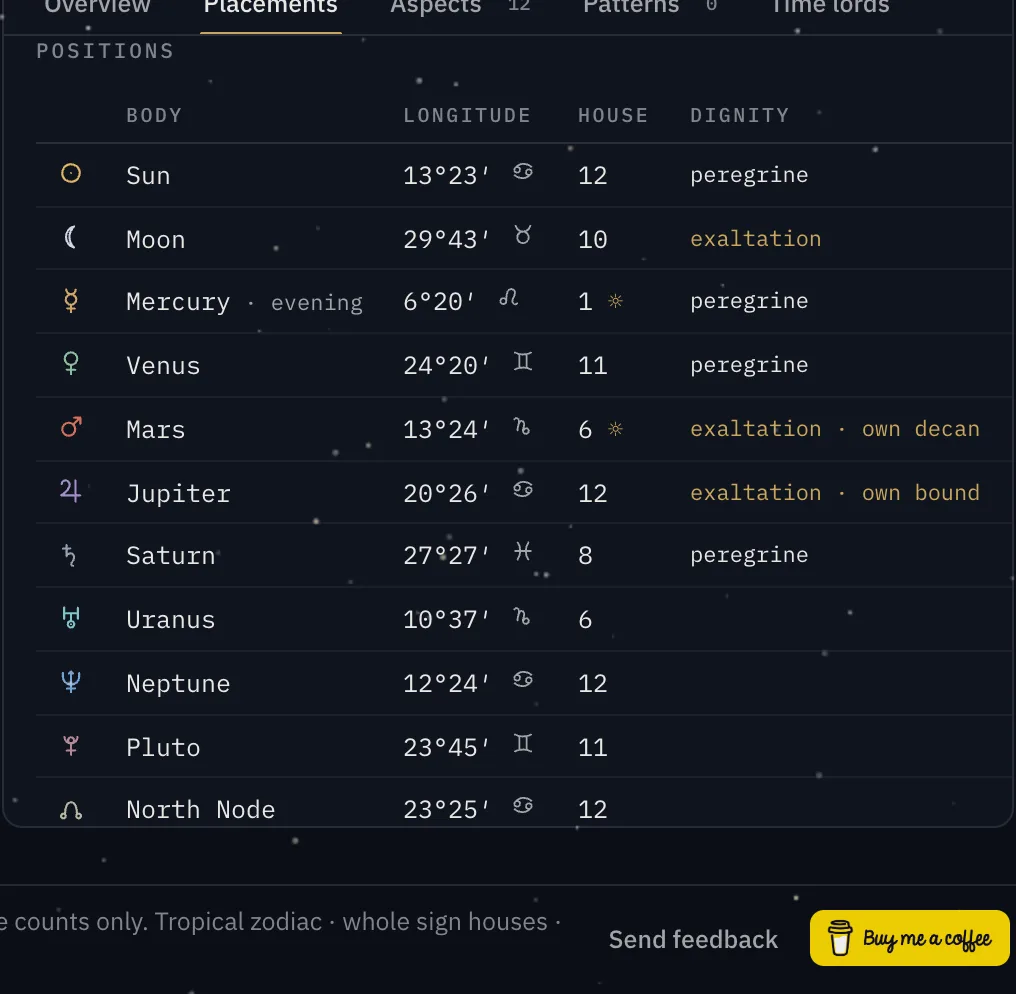
Triplicity lords depend on sect: fire signs are ruled by the Sun in a day chart and by Jupiter in a night chart. The labels lead; the points are a later shortcut, William Lilly's tally from Christian Astrology (1647), applied here to the Hellenistic tables (Egyptian bounds, Dorothean triplicities) rather than Lilly's own, and without the −5 Lilly gave a peregrine planet. Hellenistic astrologers didn't count points. They judged a planet's condition as a whole, sect and aspects included, so treat the number as a quick summary, not a verdict.
The bounds (also called terms) are the Egyptian ones. Valens lists them degree by degree in Book I of his Anthology, and Ptolemy names the Egyptian set as one of the two systems most in use in his day, before offering a variant of his own. They divide every sign into five unequal stretches, each ruled by one of the five non-luminary planets.
Lots, fixed stars and the chart ruler
- Lots. The Lot of Fortune (often called the Part of Fortune) and the Lot of Spirit use the sect-aware formulas. By day, Fortune is Ascendant + Moon − Sun. By night the Sun and Moon swap places. The Part of Fortune guide explains both.
- Fixed stars. Twenty-three bright stars of the tradition are checked against your planets and angles, conjunctions within 1° only, as traditional practice works mainly with conjunctions. See the fixed stars guide.
- Chart ruler. The traditional domicile ruler of your rising sign: Mars for Scorpio rising, Saturn for Aquarius, Jupiter for Pisces.
Time-lord techniques, built in
- Annual profections: each birthday the Ascendant moves forward one whole sign, and that sign's ruler becomes the lord of the year.
- Zodiacal releasing: Valens's method of chapters and sub-periods, as Chris Brennan teaches it, released from the Lot of Spirit, Fortune or Eros in Valens's 360-day years, in its own Chapters view.
- Firdaria: the Persian 75-year cycle of planetary periods, starting from the Sun or the Moon depending on sect.
- Primary directions: the technique Ptolemy describes for timing by the sky's daily rotation after birth, at one degree for a year. The Directions view also walks the directed Ascendant through the bounds, each bound lord taking a turn as "distributor" of the years.
- The Moment brings all of these together for any single date, down to the planetary hour.
To compare a chart with the sky, there's also the progressed Moon's phase, a transit timeline, and a planet-in-sign date finder for questions like "when was Jupiter last in Leo".
A worked reading: Elizabeth II
Traditional astrologers differ on the details, but the five steps above make a sound first reading. Here they are for Elizabeth II, from the birth data in Horoskopos's sample library (21 April 1926, 2:40 am, Mayfair, London).
- 1SectNight chart: the Sun was about 23° below the horizon
- 2Chart ruler rises, so Saturn rules: 24° Scorpio, retrograde, 11th house
- 3Sect planets Venus exalted in Pisces; Mars in its own bound
- 4The lotsFortune 9°28′ Libra, Spirit 3°18′ Taurus
- 5TimingHer firdaria begin with the Moon
Behind each step: Venus sits in the 3rd house and Mars in the 2nd. Saturn, in its own Egyptian bound, is out of sect along with Jupiter, and so is Mercury, a morning star in Aries, which joins the day team. Fortune falls in the 10th whole sign house and Spirit in the 5th, by the night formula. For timing, start with the current profection year and its lord, then the releasing chapter.
The order matters more than any single delineation. A planet's meaning depends on its condition, and its condition depends on sect, so Saturn in a night chart is read differently from Saturn in a day chart.
Accurate for old births: historical time zones and Local Mean Time
Historical charts are where many calculators go wrong. Horoskopos converts local time with the full historical time-zone database, daylight saving included. Before standardized time (before 1884) it defaults to Local Mean Time, worked out from longitude at exactly 4 minutes per degree, to the second. Odd historical offsets are kept as they were: Frida Kahlo's 1907 birth in Coyoacán uses Mexico City's UTC−6:36:36, not a rounded hour. Albert Einstein's 1879 chart in Ulm, in Local Mean Time, puts the Ascendant at 11°39′ Cancer, within a minute of arc of the 11°38′ published for his birth-certificate time in Astro-Databank. The methods page sets out how every position is calculated and tested.
Free, with no email and no sign-up
Charts are saved in your browser, a share link carries the chart data in the link itself, and you can download a backup file whenever you like. Unless you choose to sign in to sync charts between devices, nothing you enter leaves your device. The only measurement is an anonymous, cookieless page count, with chart details stripped out before it's sent.
Don't know your birth time? Tick "time unknown". The chart is drawn for noon without an Ascendant or houses rather than with made-up ones, and sect, the lots, profections, firdaria and zodiacal releasing are left out too, since they all need the time.
Sources and further reading
- Vettius Valens, Anthology (trans. Mark T. Riley, free PDF at Skyscript). Book I gives the Egyptian bounds; Book II opens with the triplicities and the two sects; Book IV sets out zodiacal releasing.
- Claudius Ptolemy, Tetrabiblos (trans. F. E. Robbins, Loeb, 1940; online at LacusCurtius). Book I covers diurnal and nocturnal planets, the planets' houses, triplicities, exaltations and the bounds.
- Dorotheus of Sidon, Carmen Astrologicum (trans. David Pingree, 1976; and Benjamin Dykes, 2017). The source of the sect-based triplicity lords and much of the early practice of lots and whole sign houses.
- Chris Brennan, Hellenistic Astrology: The Study of Fate and Fortune (Amor Fati Publications, 2017). The standard modern survey of the tradition's history and techniques, including sect, houses, lots and releasing.
- Demetra George, Ancient Astrology in Theory and Practice, Vol. I: Assessing Planetary Condition (Rubedo Press, 2019). A workbook on judging planets by sect, rulership, exaltation, triplicity and bounds.