Fixed Stars in Your Birth Chart: Which Stars Touch Your Planets
Updated October 4, 2026
A fixed star matters in your natal chart when it sits on one of your planets or angles, at the same degree of the zodiac. Most charts have a few contacts within 1°, and some have none.
Positions for 1 October 2026. The four royal stars are highlighted, roughly a quarter of the zodiac apart. Notice the crowd in Gemini and Cancer: a planet there has many chances of a star contact.
How to find fixed stars in your natal chart
- 1Enter your birth detailswith a birth time if you have one
- 2Open Placementsthe Fixed stars card lists each contact
- 3Read the rowthe star, what it sits on, the orb, and its planetary nature; hover for a line of lore
- 4Look at the wheela small star mark twinkles past the rim wherever a star touches a point
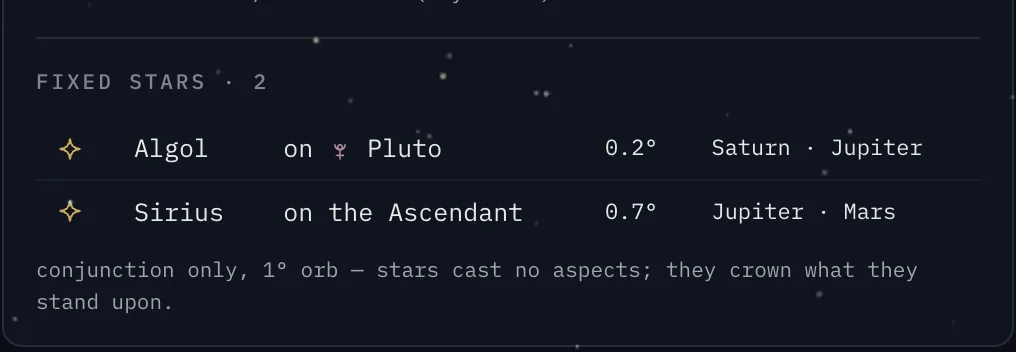
Enter your birth details to see your own. Royal stars carry a ROYAL tag, and the chart announces one a few seconds after it opens. Stars are on by default (switch them off under the wheel's display options). Without a birth time only the planets are checked.
What are fixed stars in astrology?
The ancients called them "fixed" because, unlike the planets, they keep their places relative to one another. In the Tetrabiblos (book I, chapter 9), Ptolemy passed on his predecessors' observations of the stars' "temperatures", likening each to one or two planets: Aldebaran, the bright star of the Hyades, is like Mars; Spica is like Venus and, to a lesser degree, Mars. A star was read as coloring whatever planet or angle it stood on. They are not quite fixed in the tropical zodiac, though: precession carries every star slowly forward through the signs, so a star list needs a date.
The stars Horoskopos checks
Among the brightest and most often cited stars of the tradition, not a complete list: Robson alone describes over a hundred. Positions are for 1 October 2026, to the completed minute. The natures are Ptolemy's, as Vivian Robson collected them in The Fixed Stars and Constellations in Astrology (1923), with two notes. For the Pleiades, Ptolemy wrote Moon and Jupiter, while Robson gives Alcyone as Mars and the Moon; Horoskopos follows Robson. For Antares, both say Mars and, to some degree, Jupiter.
| Star | Position (2026) | Nature | Royal |
|---|---|---|---|
| Algol | 26°32′ Taurus | Saturn, Jupiter | |
| Alcyone (Pleiades) | 0°22′ Gemini | Moon, Mars | |
| Aldebaran | 10°09′ Gemini | Mars | yes |
| Rigel | 17°12′ Gemini | Jupiter, Saturn | |
| Capella | 22°14′ Gemini | Mars, Mercury | |
| Betelgeuse | 29°08′ Gemini | Mars, Mercury | |
| Sirius | 14°27′ Cancer | Jupiter, Mars | |
| Canopus | 15°20′ Cancer | Saturn, Jupiter | |
| Castor | 20°36′ Cancer | Mercury | |
| Pollux | 23°35′ Cancer | Mars | |
| Procyon | 26°09′ Cancer | Mercury, Mars | |
| Alphard | 27°39′ Leo | Saturn, Venus | |
| Regulus | 0°12′ Virgo | Mars, Jupiter | yes |
| Denebola | 21°59′ Virgo | Saturn, Venus | |
| Vindemiatrix | 10°19′ Libra | Saturn, Mercury | |
| Spica | 24°12′ Libra | Venus, Mars | |
| Arcturus | 24°36′ Libra | Mars, Jupiter | |
| Antares | 10°08′ Sagittarius | Mars (and Jupiter) | yes |
| Vega | 15°41′ Capricorn | Venus, Mercury | |
| Altair | 2°09′ Aquarius | Mars, Jupiter | |
| Deneb Algedi | 23°55′ Aquarius | Saturn, Jupiter | |
| Fomalhaut | 4°14′ Pisces | Venus, Mercury | yes |
| Scheat | 29°44′ Pisces | Mars, Mercury |
What orb to use for fixed stars
- Conjunction only
- Within 1° of longitude
- Conjunction, opposition and parallel
- Wide orbs by brightness: 7°30′ for a first-magnitude star, down to 1°30′ for a fourth
Sources vary a good deal; the 1° conjunction is Horoskopos's choice. Conjunction is the contact nearly every author uses, many astrologers today work much tighter than Robson, and a 1° orb keeps the list to contacts most writers would agree on. The app checks the ten planets plus the Ascendant and Midheaven (and the asteroids and Chiron if you've turned them on), so a handful of contacts is typical.
The contact is measured along the ecliptic, as in most traditional practice, so stars far north or south of it, like Canopus (about 76° south) or Vega (about 62° north), count by zodiac degree even though in the sky they sit nowhere near the planets. Parans, the method Bernadette Brady built a modern practice on in Brady's Book of Fixed Stars (1998), work differently: they pair a star with a planet that rises, culminates or sets at the same moment. Horoskopos does not compute parans.
Precession: why star positions move about 1° every 72 years
The equinoxes slide backward against the stars by about 50 arcseconds a year, so every star's zodiac position grows by that much: about 1° every 72 years, a full sign in roughly 2,150. Horoskopos carries each star's standard 2000 position to your birth date at that rate. Aldebaran stood at 8°23′ Gemini in 1900 and at 10°09′ Gemini in 2026; Regulus, long the "heart of the Lion" at the end of Leo, crossed into Virgo around 2012. The stars' own motions are ignored: even fast-moving Arcturus shifts less than a tenth of a degree in three centuries.
The four royal stars: Aldebaran, Regulus, Antares, Fomalhaut
Known in modern astrology as the royal stars of Persia, or the watchers, these four sat near the equinox and solstice points around 3000 BCE. Robson repeats the story that the Persians honored them then (and derives Antares's name from "rival of Mars"); Horoskopos uses his assignment of the quarters.
The Persian link is much thinner than the lore suggests. The Zoroastrian Bundahishn does name four star chieftains of the quarters, Tishtar in the east, Sataves in the west, Vanand in the south and Haptoring in the north, but Tishtar is usually identified with Sirius and Haptoring with the stars of the Great Bear. In a 1945 article in Popular Astronomy, George A. Davis Jr. traced the "royal stars" reading to the French astronomer Jean-Sylvain Bailly, who proposed these four in 1775, and found no Persian source that calls any stars royal. Treat them as a modern tradition with an ancient-sounding story.
Brady's well-known modern readings give each a promise of success with a test attached: integrity for Aldebaran, avoiding revenge for Regulus, obsession for Antares, keeping ideals pure for Fomalhaut. Read these as themes, not sentences.
Notable stars: Algol, Spica, Sirius, Arcturus and others
Algol has the darkest reputation in the tradition and Spica one of the most favorable. Older and newer readings often differ in tone:
| Star | Nature | Robson (1923) | Brady (1998) |
|---|---|---|---|
| Algol, the Gorgon's head in Perseus | Saturn, Jupiter | "the most evil star in the heavens" | raw, passionate power, difficult but not evil |
| Spica, the ear of wheat in the Virgin's hand | Venus, something of Mars | success, renown, a sweet disposition | a great gift |
| Sirius, brightest in the night sky; the name is usually glossed "the scorcher" | Jupiter, something of Mars | honor, renown, ardor | brilliance |
| Arcturus, the bear-guard, near Spica in longitude | Jupiter and Mars (Ptolemy) | self-determination, prosperity by navigation | |
| Vega, in the Lyre | Venus, Mercury | charisma | |
| Capella, the she-goat | Mars, Mercury | natives inquisitive and fond of novelty |
Stars on the angles: a worked example
A star on the Ascendant or Midheaven is usually read as among the most prominent contacts, because the angles are the most personal points in the chart. From the sample library:
| Chart | Contacts within 1° |
|---|---|
| Albert Einstein | Sirius on the Ascendant (0.75°); Algol on Pluto (0.24°) |
| Frida Kahlo | Canopus on the Sun (0.30°); Sirius on Neptune (0.39°) and on the Sun (0.59°); Vega on Mars (0.63°); Scheat on Saturn (0.63°) |
| Elizabeth II | Deneb Algedi on Jupiter (0.01°); Sirius on Pluto (0.34°); Scheat on Uranus (0.98°) |
Einstein's Ascendant is 11°39′ Cancer, and Sirius in 1879 stood at 12°24′ Cancer: a well-documented example of Sirius conjunct the Ascendant, shown in the screenshot above. Kahlo has no star on her angles. If you still have the sample library, open Einstein's chart.
For angle contacts the birth time matters: the Ascendant moves about a degree every four minutes, so ten minutes can make or break a 1° contact. Planet contacts barely depend on the time, except for the Moon, which moves about half a degree an hour.
Sources and further reading
- Claudius Ptolemy, Tetrabiblos, book I, chapter 9, "Of the Power of the Fixed Stars" (trans. F. E. Robbins, Loeb, 1940): the planetary natures of the stars, constellation by constellation.
- Vivian E. Robson, The Fixed Stars and Constellations in Astrology (1923): star-by-star natures, traditional meanings, and his orbs by magnitude.
- Bernadette Brady, Brady's Book of Fixed Stars (Samuel Weiser, 1998): the modern paran method and the royal-star readings quoted above.
- George A. Davis Jr., "The So-Called Royal Stars of Persia", Popular Astronomy 53 (1945), pp. 149–158: where the royal-stars story came from, and why the Persian sources don't support it.
- The Bundahishn, chapter 2 (trans. E. W. West, Sacred Books of the East, vol. 5, 1880): the four star chieftains of the quarters.