Your Chart Ruler: The Planet That Steers Your Birth Chart
Updated October 4, 2026
Your chart ruler is the planet that rules your rising sign: Mercury for Virgo rising, Saturn for Capricorn rising. Where it sits by sign and house, and how well placed it is, is one of the first things a traditional astrologer looks at, because the Ascendant stands for you and its ruler shows where your life tends to be directed.
- Leo → Sun
- Virgo → Mercury
- Libra → Venus
- Scorpio → Mars (modern: Pluto)
- Sagittarius → Jupiter
- Capricorn → Saturn
- Cancer → Moon
- Gemini → Mercury
- Taurus → Venus
- Aries → Mars
- Pisces → Jupiter (modern: Neptune)
- Aquarius → Saturn (modern: Uranus)
How to find your chart ruler
- 1Get an accurate birth timeA birth certificate or hospital record is best
- 2Find your rising signThe sign of your Ascendant, marked AC on the wheel
- 3Look up its rulerIn the table above, or read it straight from the Signature panel
Enter your birth date, time and place and the Signature panel on the Overview tab names your chart ruler in a sentence:
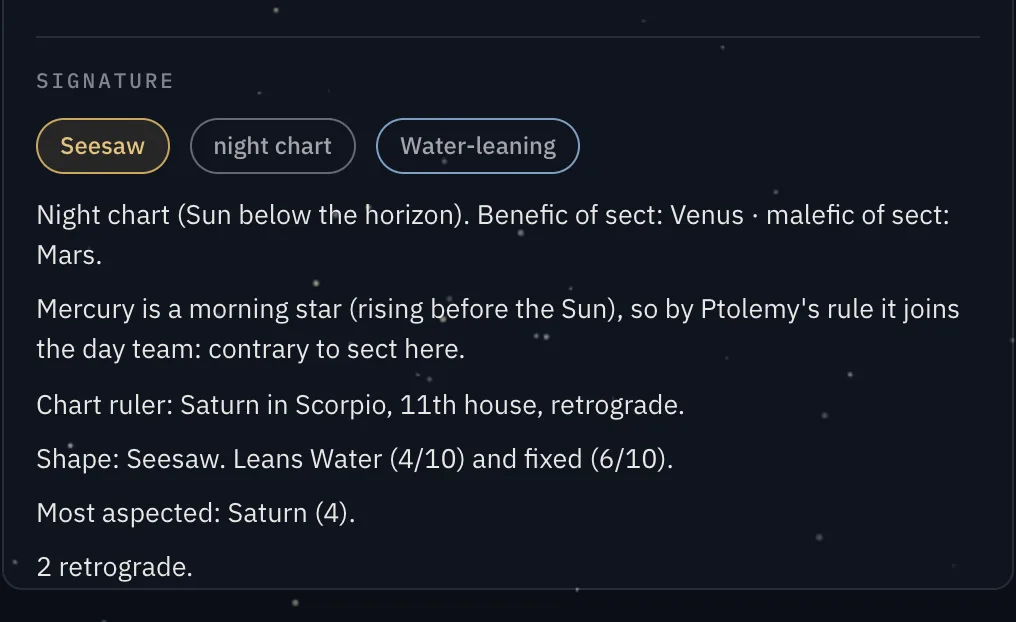
If you ticked "time unknown", Horoskopos draws the chart for noon without an Ascendant and doesn't name a chart ruler, because it can't know one.
What is a chart ruler in astrology?
The Ascendant is the degree of the zodiac rising on the eastern horizon when you were born, and the sign it falls in is your rising sign. The Greek word for it, hōroskopos, "the hour-marker", gave horoscopes their name. Each sign has a domicile lord, and the lord of the rising sign is your chart ruler, also called the ruler or lord of the Ascendant. Chris Brennan, following the Greek, calls it the ruler of the hour-marker. The ancient texts use it: Valens, for one, asks whether it is well placed and in its own sect when he judges length of life.
One caution if you read the old books. Ancient authors also looked for a "master of the nativity" (oikodespotēs), worked out in more complicated ways, for example from the bound lord of the Ascendant degree or from rulers connected to the Sun and Moon. The ruler of the rising sign can fill that role, but it isn't the master by default. Today "chart ruler" almost always means the ruler of the Ascendant, and that's what Horoskopos shows.
"My chart ruler is Pluto?" Modern vs traditional rulers
Before 1781, astrologers worked with the seven planets visible to the naked eye, and the rulerships formed the neat pattern in the figure above, which Ptolemy explains in Tetrabiblos I.17. The Sun and Moon each rule one sign, Leo and Cancer. Moving outward from them, each planet in the traditional order of the spheres (which is also the order of their speed) rules the next pair of signs on either side, Mercury nearest and Saturn furthest.
After Uranus (1781), Neptune (1846) and Pluto (1930) were discovered, modern astrologers gave them Aquarius, Pisces and Scorpio. Many use them as co-rulers alongside Saturn, Jupiter and Mars, and some use them in their place.
Horoskopos follows the traditional scheme, as Hellenistic and medieval astrologers did. That doesn't make Pluto unimportant: it's still drawn on your wheel and can still be prominent, for example on an angle. It just isn't assigned rulership. If you were taught that Pluto rules your chart, read your Mars as well and see which one describes you.
Your chart ruler by house
The house your chart ruler occupies shows where your attention, effort and identity tend to go. The themes mix the traditional meanings of the places with some later ones; for the 3rd, 5th, 6th, 9th, 11th and 12th the second line gives the place's traditional name, and for the others a further theme. They're for reflection, not prediction.
In fuller terms: 3rd, siblings, neighbours, short trips and everyday learning · 4th, home, family, roots and land · 5th, children, pleasure, creativity and play · 6th, work, duties and daily strain · 8th, endings, inheritance and what comes from others · 9th, travel, study, philosophy and religion · 10th, career, reputation and public action · 11th, friends, allies, groups and the hopes they help sustain.
The 6th, 8th and 12th are traditionally hard places; the 8th is also called "idle". People often ask about a chart ruler in the 12th, traditionally the place of hidden things, enemies and losses. In practice it often describes someone whose work or inner life goes on away from public view. Frida Kahlo had one, as the examples below show.
Your chart ruler's house depends on the house system. The Signature panel uses whatever system you've chosen. Whole sign is the default, and under Placidus the house can change: see whole sign vs Placidus.
Chart ruler in its own sign, exalted, or in detriment
A planet's sign shows how well it can act, and that matters more for the chart ruler than for most planets. If the Signature panel shows "(domicile)", your chart ruler is in a sign it rules, which most traditional schemes count as the strongest of the essential dignities. For the full picture, including triplicity, bound and decan, open the Placements tab and hover over the planet's dignity label.
- Sun: Leo · Aries
- Moon: Cancer · Taurus
- Mercury: Gemini, Virgo · Virgo
- Venus: Taurus, Libra · Pisces
- Mars: Aries, Scorpio · Capricorn
- Jupiter: Sagittarius, Pisces · Cancer
- Saturn: Capricorn, Aquarius · Libra
- Sun: Aquarius · Libra
- Moon: Capricorn · Scorpio
- Mercury: Sagittarius, Pisces · Pisces
- Venus: Scorpio, Aries · Virgo
- Mars: Libra, Taurus · Cancer
- Jupiter: Gemini, Virgo · Capricorn
- Saturn: Cancer, Leo · Aries
Sect counts too. A chart ruler that belongs to your chart's sect is usually easier to work with than one that doesn't. See day chart or night chart.
Three example chart rulers
From the birth data in Horoskopos's sample library:
- Cancer rises
- Ruler: Moon
- 14°32′ Sagittarius, 6th house
- In its own decan, otherwise without dignity
- Leo rises
- Ruler: Sun
- 13°23′ Cancer, 12th whole sign house (11th Placidus)
- Peregrine
- Capricorn rises
- Ruler: Saturn, retrograde
- 24°27′ Scorpio, 11th whole sign house (9th Placidus)
- In its own Egyptian bound; malefic contrary to sect in her night chart
Chart ruler vs rising sign vs dominant planet
- Rising sign vs chart ruler. The rising sign is often read as your manner and the way you meet the world. The chart ruler is the planet that carries that sign's agenda somewhere else in the chart. Read them together.
- Dominant planet. A broader judgement, combining angularity, dignity, aspects and sect, which astrologers weigh differently. Horoskopos doesn't produce a single "dominant planet" score. The Signature panel names your most-aspected planet, and the Placements tab labels each planet's dignity, with a point score in the label's tip.
- Final dispositor. Follow each planet to the ruler of its sign, then that planet's ruler, and so on. If the chain ends in a single planet in its own sign, that's the final dispositor. It's a separate idea from the chart ruler, and many charts don't have one.
How the chart ruler connects to profections
In annual profections, each year of life activates one house, starting from the 1st at birth. The cycle returns to the 1st every twelve years, at ages 0, 12, 24, 36, 48, 60, 72 and 84. In those years your chart ruler is the lord of the year, and astrologers who use profections pay its transits and condition particular attention. The Time lords tab shows your current profection year and its lord.
For how the chart ruler fits with sect, dignities and the other traditional techniques, see the Hellenistic birth chart guide.
Sources and further reading
- Claudius Ptolemy, Tetrabiblos (trans. F. E. Robbins, Loeb, 1940; online at LacusCurtius). Book I.17, "Of the Houses of the Several Planets", sets out the traditional rulership scheme and its reasoning.
- Vettius Valens, Anthology (trans. Mark T. Riley, free PDF at Skyscript). Book II uses the ruler of the Ascendant, its sect and placement in judging a nativity.
- Chris Brennan, Hellenistic Astrology: The Study of Fate and Fortune (Amor Fati Publications, 2017). Domicile rulership, the significations of the twelve places, and the rulers of the chart.
- Demetra George, Ancient Astrology in Theory and Practice, Vol. I: Assessing Planetary Condition (Rubedo Press, 2019). How to judge a planet's condition by rulership, exaltation, sect and bounds, which applies directly to the chart ruler.
- The Astrology Podcast, episode 205: "The Master of the Nativity" (Chris Brennan). How the ancient "master of the nativity" differs from the modern chart ruler.