Whole Sign vs Placidus: Why Your Planets Change Houses
Updated October 4, 2026
Whole sign houses make each zodiac sign one house, starting with your rising sign. Placidus divides the sky by time, so its houses are unequal and start partway through signs. That's why a planet can be in your 10th house in one system and your 9th in the other. Neither is a mistake: they come from different traditions and measure different things.
Her Ascendant, 21°23′ Capricorn, is at the far left. House 1 is the whole of Capricorn, so it begins 21° above the Ascendant. Each house is one sign, 30° wide.
House 1 now begins at the Ascendant and runs 57°, to 18°27′ Pisces; the 5th spans only 17°. Positions: Sun 0°12′ Taurus, Moon 12°07′ Leo, Mercury 4°40′ Aries, Venus 13°57′ Pisces, Mars 20°52′ Aquarius, Jupiter 22°31′ Aquarius, Saturn 24°27′ Scorpio.
- 1st house: the whole rising sign, 0° to 30°
- Size: every house exactly 30°
- Midheaven: a point inside a house, usually the 9th, 10th or 11th
- Interceptions: never
- Birth-time error: houses change only if the Ascendant changes sign
- Latitude: works anywhere
- Origin: assumed in most Hellenistic texts
- 1st house: starts at the Ascendant degree
- Size: unequal, from 17° to 57° in Elizabeth II's chart
- Midheaven: the 10th house cusp
- Interceptions: common away from the equator, where some signs hold no cusp and others two
- Birth-time error: every cusp shifts with every minute
- Latitude: can't be calculated above about 66°
- Origin: named after Placidus de Titis (1603–1668)
Why did my planet move houses?
Any planet between a sign boundary and a Placidus cusp changes house when you switch, and how many do depends on your latitude and rising sign. In Elizabeth II's chart (21 April 1926, 2:40 am, London, from Horoskopos's sample library) all seven traditional planets move. Her Sun, at 0°12′ Taurus, is in the 5th whole sign house but falls about 6′ short of the Placidus 3rd cusp at 0°19′ Taurus, so Placidus counts it in the 2nd. Had she been born about 20 seconds earlier, Placidus would put it in the 3rd.
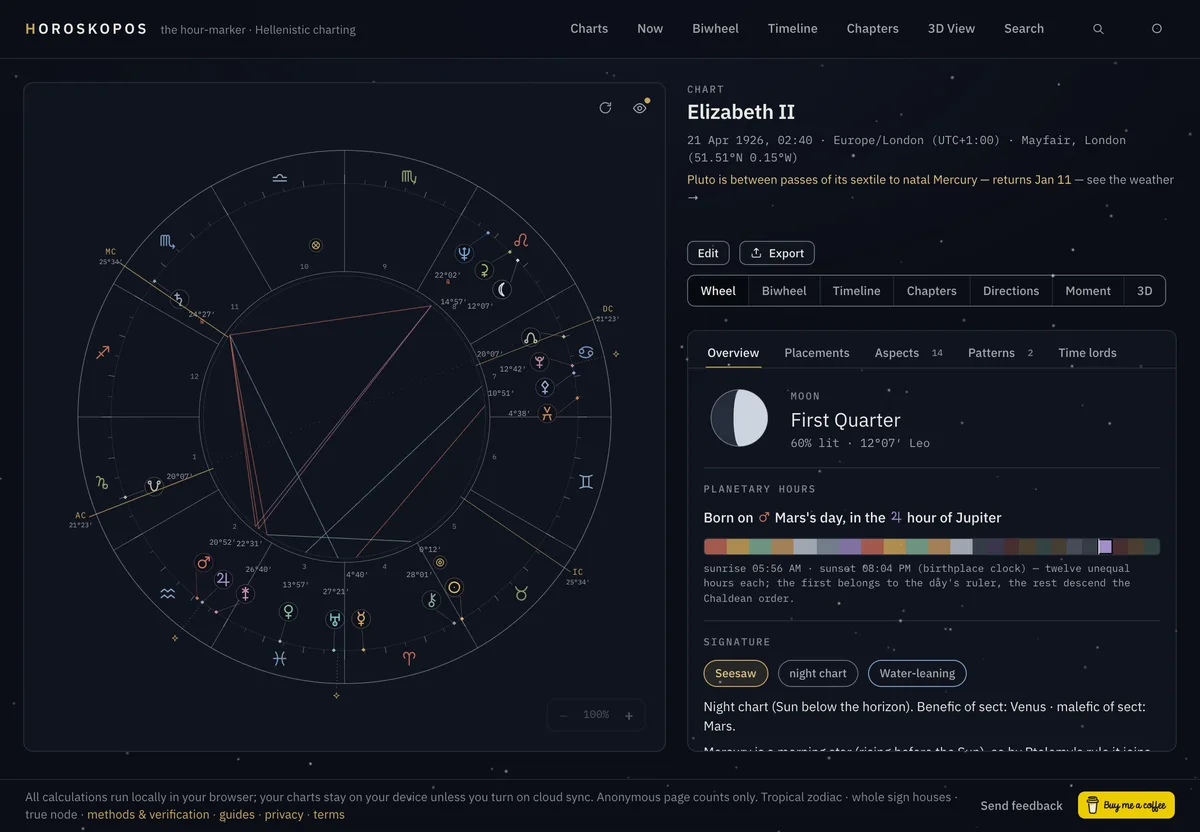
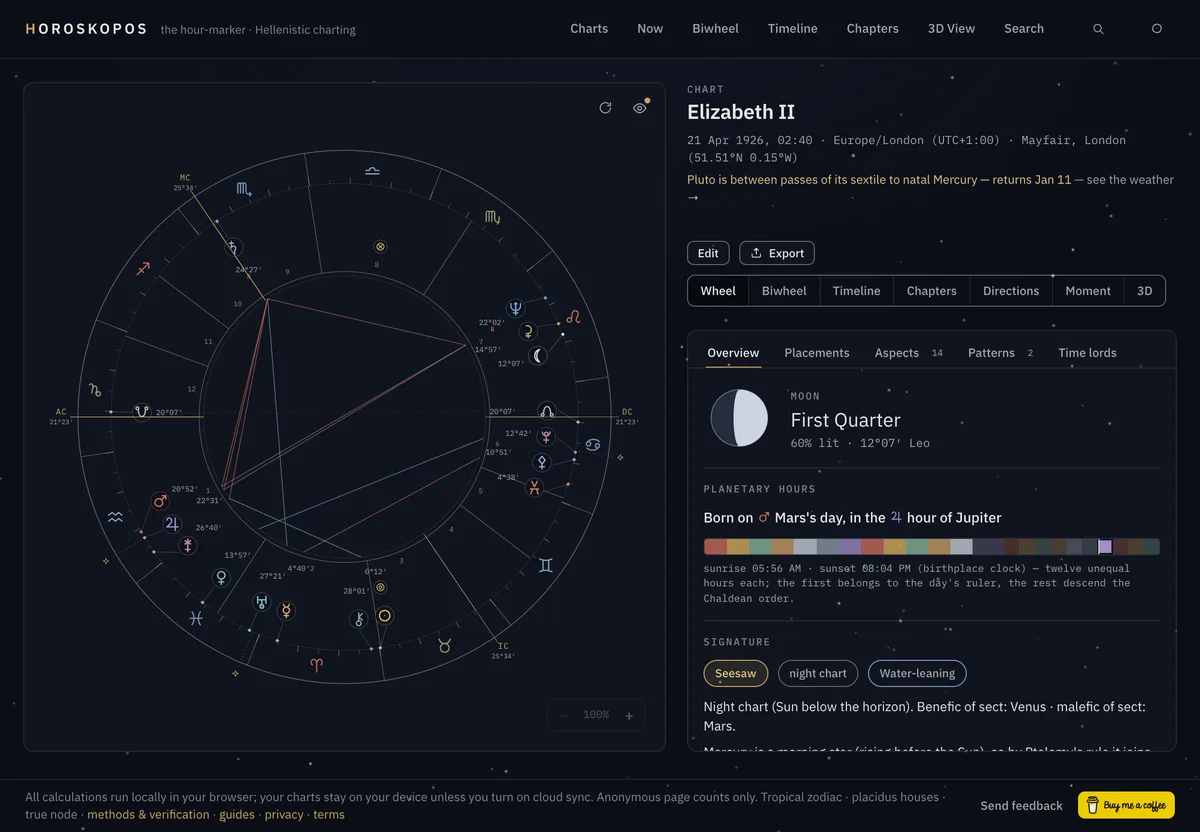
Intercepted signs. Uneven houses cause interceptions. In her Placidus chart Aquarius, Aries, Leo and Libra contain no house cusp at all: they're swallowed inside a larger house. Taurus, Cancer, Scorpio and Capricorn each hold two cusps. Whole sign houses never produce interceptions, since every sign is exactly one house.
Lower latitudes, smaller shifts. Frida Kahlo, also in the sample library, was born in Coyoacán at 19°N, where Placidus houses come out close to 30° each. Planets still move. Mercury at 6° Leo is in her 1st whole sign house, since Leo rises, but in her Placidus 12th: it sits about 17° before the 23°31′ Leo Ascendant, so it had already risen. Her Sun moves from the 12th to the 11th.
High latitudes. Above roughly 66° north or south, part of the zodiac never rises or never sets, and Placidus can't be calculated. Horoskopos then draws the chart in Porphyry and says so in the chart header.
What are whole sign houses?
The sign on the eastern horizon at your birth is your 1st house, all 30° of it, whether your Ascendant is at 2° or 28° of it, and the next sign is the 2nd. The Ascendant and Midheaven become sensitive points inside houses, not their boundaries; the Midheaven usually falls in the 9th, 10th or 11th sign, and at high latitudes occasionally in the 8th or 12th.
Chris Brennan and other historians of the tradition argue that it's the oldest house system in Western astrology. James Holden made the case in 1982, and Brennan's survey of the surviving Hellenistic charts finds that the great majority record only the rising sign, which leaves whole signs as the only house division they could have used. It's the system assumed in most Hellenistic texts, including Dorotheus and Valens. It stayed in use in Indian astrology, and Western astrologers revived it after Holden's paper, especially once Robert Schmidt and Robert Hand's Project Hindsight began translating the Greek and Latin texts in the 1990s.
How Placidus divides the sky
Placidus de Titis (1603–1668), an Italian monk and mathematician, popularized the system, though Abraham ibn Ezra had described the same method in the twelfth century. The Ascendant, IC, Descendant and Midheaven open the 1st, 4th, 7th and 10th houses, and each quarter between them is split by time: the 12th cusp is the degree that has covered one third of its path from rising to culminating, the 11th two thirds, and the houses below the horizon are divided the same way.
Because the ecliptic is tilted against the equator, some signs rise quickly and others slowly, so equal slices of time cover very unequal stretches of zodiac. Placidus became the default in English-language astrology largely because of tables: from 1821 R. C. Smith ("Raphael") published Placidus tables of houses in his popular almanac, and for generations they were the most widely available and affordable tables an astrologer could buy.
Is whole sign or Placidus more accurate?
Neither, in the way an ephemeris can be: both are calculated precisely from the same Ascendant and Midheaven. The real question is what you think a house is.
- Whole sign treats houses as topics attached to signs. The 10th house is the 10th sign from the rising sign, and its ruler is that sign's ruler. Houses, sign rulers and aspects (also counted sign to sign in Hellenistic astrology) fit together neatly, and it's what techniques like annual profections assume.
- Placidus treats houses as zones of the sky's daily motion, measured in time. Quadrant division is old too. Valens divides each quadrant into thirds to decide which degrees are powerful and which are weak (Anthology III.2 in Riley's translation). Many medieval astrologers worked with other quadrant systems, such as Alchabitius and later Regiomontanus, the system William Lilly used in the seventeenth century.
If you practise Hellenistic astrology, whole sign is the natural fit. Later medieval and Renaissance techniques were usually taught with quadrant houses, and many modern psychological astrology books assume Placidus. Plenty of astrologers use whole signs for topics and quadrant divisions for how strong or active a planet is. The honest test is to read your chart both ways.
Whole sign or Placidus for transits, synastry and solar returns?
- Transits. Under whole sign, a transiting planet changes house when it changes sign. Under Placidus, it changes house at a cusp degree, which can be mid-sign. Use the same system as your natal chart, or the two won't line up.
- Synastry. Your partner's planets land in your houses, so the house system is yours. In Horoskopos's biwheel your natal houses follow whichever system you've chosen.
- Solar returns. Horoskopos casts the return for the moment the Sun comes back to its natal degree, over your birthplace (some astrologers use where you are on the birthday). Its biwheel places the return planets in your natal houses, in whichever system you've chosen.
Annual profections and zodiacal releasing always count whole signs, whichever system you pick, because that's how those techniques are defined. See the annual profections guide.
What about Porphyry, Equal and Koch?
- Equal houses start the 1st house at the Ascendant degree and make every house exactly 30°. It's attested in the Hellenistic period too, never produces interceptions, and lets the Midheaven float free of the 10th cusp, as in whole sign.
- Porphyry, named after the third-century philosopher, divides each quarter between the angles into three equal stretches of zodiac, a trisection that already appears in Valens a century or so earlier. It's unequal but works at any latitude.
- Koch is a twentieth-century quadrant system, popular with some modern astrologers. Horoskopos doesn't offer it; its four systems are Whole sign, Equal, Porphyry and Placidus.
Unsure of your birth time? Whole sign is more forgiving
Under whole sign houses, your houses change only if a time error moves the Ascendant into another sign, which it does roughly every two hours on average, though some signs rise faster than others. Under Placidus every cusp shifts with every minute, so a birth time rounded to the quarter hour can move planets near a cusp into a different house.
If your Ascendant is mid-sign, whole sign houses will hold even if your time is out by twenty minutes or so; near 0° or 29°, treat the rising sign as uncertain under either system. With "time unknown" ticked, Horoskopos calculates the chart for noon and leaves houses out rather than inventing them.
Compare your chart in both systems
- 1Draw your chartEnter your birth date, time and place
- 2Open Display optionsThe eye icon above the wheel
- 3Pick a system under HousesWhole sign, Equal, Porphyry or Placidus. Or press ⌘K / Ctrl+K and type "Placidus houses"
- 4Watch what movesThe wheel redraws; Placements and the Signature panel update every house number
Start with your birth details. Your choice is remembered in this browser and also applies to the biwheel, the printable report and your chart ruler's house in the Signature panel. For sect, dignities, lots and the time lords, see the Hellenistic birth chart guide.
Sources and further reading
- Vettius Valens, Anthology (trans. Mark T. Riley, free PDF at Skyscript). Counts places sign by sign throughout; Book III.2 trisects the quadrants to find the powerful degrees.
- James H. Holden, "Ancient House Division" (AFA Journal of Research, 1982). The paper that first argued whole sign houses were the original system.
- Chris Brennan, Hellenistic Astrology: The Study of Fate and Fortune (Amor Fati Publications, 2017). The history of whole sign, equal and quadrant division in the Hellenistic texts and charts.
- The Astrology Podcast, episode 227: "Origins of the House Division Debate in Ancient Astrology" (Chris Brennan). The evidence from surviving ancient charts, and where equal and quadrant houses come in.
- The Astrology Podcast, episode 244: "How Did Placidus Become the Most Popular House System?" (Chris Brennan with Anthony Louis). Placidus's predecessors, his book, and the role of Raphael's tables.