Your Planetary Hour of Birth, and Today's Planetary Hours
Updated October 4, 2026
Your planetary hour of birth is the planet that ruled the stretch of time you were born in. Daylight at your birthplace is split into twelve equal hours and the night into twelve more; the first hour after sunrise goes to the ruler of the day, and each later hour to the next planet in the Chaldean order.
London, 20–21 April 1926. Sunrise 05:56, sunset 20:04, next sunrise 05:54 (British Summer Time). She was born at 02:40 on Wednesday morning, before sunrise, so still in Tuesday's planetary day, in the outlined hour of Jupiter.
What planetary hour was I born in?
Enter your birth details with a birth time and place. On the Overview tab, the Planetary hours card names your planetary day and hour, above a strip of all twenty-four hours from the sunrise before your birth to the sunrise after, with a marker where your birth fell. Hover any hour for its planet and its start and end times.
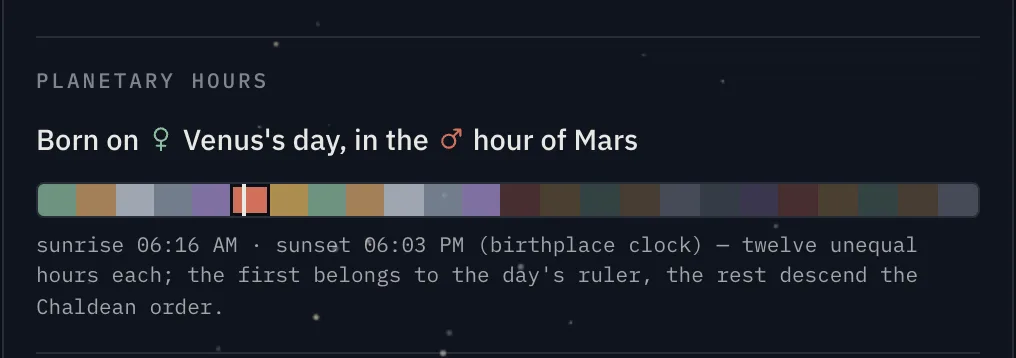
Without a birth time the hour can't be known, so the card stays hidden.
How are planetary hours calculated?
- 1Find the Sun's timessunrise, sunset and the next sunrise at the place
- 2Split the daysunrise to sunset, divided by twelve
- 3Split the nightsunset to the next sunrise, divided by twelve
- 4Hour 1 to the day's rulerthe planet that names the weekday: Sunday , Saturday
- 5Then the Chaldean order , and round again
These are unequal, or "seasonal", hours, the kind the Greek and Roman world kept time by: long by day in summer, long by night in winter, close to sixty minutes at the equinoxes. The Chaldean order is the ancient order of the planetary spheres, from Saturn, the slowest and supposedly most distant, inward to the Moon.
Horoskopos takes sunrise and sunset from astronomy-engine for the exact coordinates you enter. Above the polar circles, on days when the Sun never rises or never sets, the hours aren't defined, and the app shows nothing rather than inventing them.
Worked examples from the sample library
| Chart | Born | Planetary day | Hour of birth | That hour ran |
|---|---|---|---|---|
| Albert Einstein | Fri 14 Mar 1879, 11:30 LMT, Ulm | Venus | Mars (6th day hour) | 11:10–12:09 |
| Frida Kahlo | Sat 6 Jul 1907, 08:30, Coyoacán | Saturn | Mars (3rd day hour) | 07:39–08:45 |
| Elizabeth II | Wed 21 Apr 1926, 02:40, London | Mars | Jupiter (9th night hour) | 02:37–03:26 |
Elizabeth II's hour of Jupiter had begun less than three minutes before her birth, and because the planetary day runs sunrise to sunrise, her Wednesday birth falls on Mars's day. In early July in Mexico City, Kahlo's day hours lasted about 66 minutes and her night hours about 54. If you still have the sample library, open Elizabeth II's chart to see her strip.
Why your birthplace's clock matters
A birth hour only makes sense on the clock of the place where it happened, so a birth chart shows the hour strip, sunrise and sunset in the birthplace's clock, labeled as such, wherever you open it. The weekday that names the planetary day is reckoned there too. That clock is often not today's time zone:
- Local mean time. Before standard time zones arrived, country by country from the 1880s on, clocks ran four minutes per degree of longitude. Ulm sits at 10°E, so Einstein's 11:30 was 40 minutes ahead of Greenwich. For births before 1884 Horoskopos selects local mean time by default (you can change it).
- Historical offsets. Mexico had no standard time until 1922; the time-zone database puts Mexico City in 1907 at UTC−6:36:36, and the app uses that.
- Summer time. Elizabeth II's 02:40 was British Summer Time, an hour ahead of Greenwich.
A planetary hour lasts about an hour, so a birth time rounded to the half hour can land in the wrong one: Kahlo's recorded 08:30 falls fifteen minutes before her hour of Mars gave way to the Sun. If your time is approximate, look at where your birth sits on the strip.
Planetary days: why Saturday is Saturn's day
- Saturn
- Jupiter
- Mars
- Sun
- Venus
- Mercury
- Moon
- Saturday
- Thursday (Spanish jueves)
- Tuesday (Spanish martes)
- Sunday
- Friday (Spanish viernes)
- Wednesday (Spanish miércoles)
- Monday
The hours explain the order of the week. A day has 24 hours, and 24 divided by 7 leaves 3, so each day's first hour falls three steps further down the Chaldean order than the last: Saturn, then the Sun, the Moon, Mars, Mercury, Jupiter, Venus. That is Saturday through Friday. English swapped four of the planets for the Germanic gods Tiw, Woden, Thor and Frigg; most Romance languages kept them.
Writing in the early third century, the Roman historian Cassius Dio (Roman History 37.18–19) said the custom of naming days after the planets came from Egypt and had spread only recently. One of his two accounts of the order is exactly this count of hours. "Chaldean order" is a later label; Dio calls it the order the Egyptians observe.
What each planetary hour is good for
In the tradition, planetary hours are mainly for choosing a time to begin something (elections) and judging the moment a question is asked (horary). In Christian Astrology (1647), William Lilly counts a horary chart fit to judge when the ruler of the hour and the ruler of the Ascendant are the same planet, share a triplicity, or are of the same nature. Natal astrology has made much less of the hour of birth, so treat yours as a flavor rather than a verdict.
The older lists are blunter than modern summaries. The right-hand column condenses Henry Coley's Clavis Astrologiae Elimata (1676); the middle one is a gentler modern reading from each planet's general nature.
| Hour of | Modern summary | Coley (1676), condensed |
|---|---|---|
| Saturn | Patient or structural work; finishing, clearing away | Avoid journeys and new servants; good for buying or leasing land and houses, buying grain, digging and ploughing |
| Jupiter | Learning, generosity, asking a favor | Seeking the favor of clergy, judges and the powerful; journeys, sowing and planting, marriage |
| Mars | Courage, competition, vigorous effort | Begin nothing of worth; unfortunate for almost everything |
| Sun | Being seen, meeting people of standing | Generally unfortunate, except for approaching great persons or receiving preferment |
| Venus | Art, pleasure, friendship, love | Courtship, pastimes, marriage; starting a journey by land |
| Mercury | Writing, study, messages, trade | Buying and selling, letters and messengers, sending children to school, apprenticeships |
| Moon | Short journeys, home life, the public | Courtship, sending children to school, setting out on a journey; not for building or lending |
Coley himself adds that these meanings carry less weight than a well-chosen chart for the moment, and a Venus hour with Venus badly placed was never thought to work like one with Venus strong.
Today's planetary hours for your location
Open the current sky and choose Use my location (it stays on your device). The header reads something like "Venus's day, hour of Mars", the Overview tab shows today's strip on your own clock, and the time bar under the wheel steps by minutes, hours or days to find the next Venus or Jupiter hour.
The Moment page shows the day and hour as the two fastest rings of its dial, alongside your other time-lords. It counts them at your chart's birthplace, so if you've moved, use the current sky for the hours where you live now.
Sources and further reading
- Cassius Dio, Roman History, book 37, chapters 18–19 (trans. Earnest Cary, Loeb, 1914): one of the earliest surviving explanations of the planetary week, including the count of hours.
- William Lilly, Christian Astrology (1647): the "considerations before judgement", including the test that compares the lord of the hour with the Ascendant.
- Henry Coley, Clavis Astrologiae Elimata, book 2, section IV (1676; transcribed by Christopher Warnock): a period list of what each planetary hour suits.
- Christopher Warnock, "The Planetary Hours in Renaissance Horary and Electional Astrology": how Lilly, Coley, Dariot and others actually used the hours.